
Every episode, in your inbox
One email per Travel Tech Podcast episode: the conversation, the key takeaways and the use cases worth building in aviation and travel AI.
Fly First, Regulate Later: Why Europe's Rules Are Pushing Drones Abroad
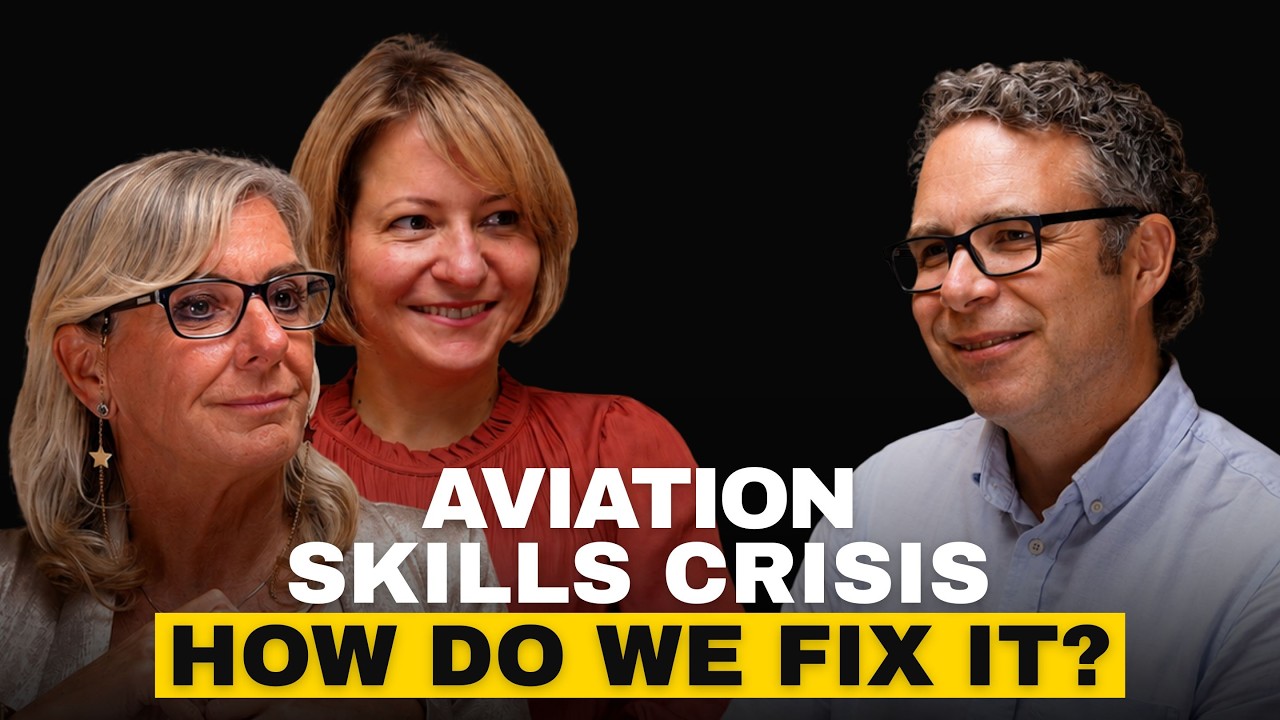
Europe keeps writing the rulebook before anyone is allowed to fly — and drone operators are voting with their feet, taking their expansion to the US, UK, and UAE instead. Julie Garland, CEO of Avtrain and president of the Joint European Drone Associations, and Sarah Owen, VP for Europe Travel and Transportation at Sutherland and chair of the Aviation Club of the UK, join host Alex Brooker for the podcast's first in-person recording to unpack why regulatory sequencing, data silos, and a stalled gender pipeline are shaping the future of aviation.
Show Notes
Julie Garland and Sarah Owen bring a combined career span that covers almost every corner of aviation to the Travel Tech Podcast's first in-person episode, recorded in London. Julie is CEO of Avtrain, Europe's leading drone training and certification body, and president of the Joint European Drone Associations; she began as an aircraft maintenance engineer with Aer Lingus, progressed to commercial captain and type-rating instructor, then qualified as a barrister specialising in aviation law before pivoting into drone regulation — a sequence she frames as deliberate ten-year blocks rather than a single fixed path. Sarah Owen, VP for Europe Travel and Transportation at Sutherland and chair of the Aviation Club of the UK Forum, has held senior roles at Google, Salesforce, and Cyient, and led commercial strategy at Assaia, a computer vision company focused on aircraft turnaround. Together they examine why Europe's regulate-first approach contrasts sharply with the operate-then-regulate models in the US and China, and why missing planning, noise, and airspace-access frameworks — not the drones themselves — are pushing some European delivery operators to concentrate expansion in the US, UK, and UAE. The conversation also covers AI tools such as OptiFlight, which already cuts fuel burn by roughly 5–6% during climb by rebalancing thrust in real time, the data-silo problem that prevents airports, handlers, and airlines from sharing operational intelligence, the drone industry's nascent push toward a just culture of mandated safety reporting, and the stubbornly stalled gender statistics — female representation sitting around 5% across pilots and air traffic controllers and as low as 2–2.5% in maintenance — that both guests argue the industry must confront far more urgently.
Read the takeaways
Fly First, Regulate Later: Why Europe's Rules Are Pushing Drones Abroad
Julie Garland started as an aircraft maintenance engineer on Aer Lingus heavy checks, went on to fly as a commercial captain, then qualified as a barrister specializing in aviation law before…
Read the newsletter issueFull TranscriptClick to expand (12,122 words approx.)
Alex Brooker: Hey everybody, welcome to this week's episode of the Travel Tech Podcast. I'm Alex Brooker. Now this one really is special. I actually met my two guests face-to-face this episode and we have a deep conversation, wide-ranging conversation across the aviation industry about AI, about careers, skills, shortages and more.
Now these two guests are very, very special. First one has done almost every job there is in aviation. Julie Garland started out as an aircraft maintenance engineer working heavy checks on Boeing's at Aer Lingus. She went on to fly as a commercial captain and type rating instructor and then qualified as a barrister specialising in aviation law. She's run quality and compliance for airlines across Europe. And today she's CEO of AvTrain, Europe's leading drone training and certification body, which is also president of the Joint European Drone Associations and vice chair of the JARIS industry stakeholder group, helping shape how the world regulates uncrewed flight.
Engineer, pilot, barrister, regulator, chief executive. If it flies, Julie has probably fixed it, flown it or written the rules for it. I'm so happy that Julie joined us for this in-person episode of Conversation in London.
My second guest, Sarah Owen. Now Sarah lives right where aviation meets technology. Sarah has spent her career bringing the biggest names in tech into aerospace, with senior roles at Google, Salesforce and SITA. She then led commercially at Assaia, where computer vision is changing how aircraft turn around on the apron. Today she's VP for Europe Travel and Transportation at Sutherland. Sarah chairs the Aviation Club of the UK Forum and she sits on the Council of the Royal Aeronautical Society. Sarah knows this industry inside out and she has a sharp eye for where it's heading.
It's amazing that Sarah agreed to join us for this conversation, perfectly timed for the run into the Farnborough International Air Show, which is in just a few days' time. I really hope you enjoy this in-person conversation — a big milestone for the podcast.
Hey, brought to you by Airside Labs — that's airsidelabs.com. Please don't forget to like and subscribe to the channel, it really helps me out. Thank you so much for your comments, feedback and suggestions. And if you have a story to tell that covers the intersection of AI, travel and aviation, then please do get in touch.
This one's special. I hope you enjoy it. Cheers. Let's get into it.
Hi everybody, welcome to the Travel Tech Podcast for a very special episode — actually in person, face to face for the very first time. I'm super excited to be joined by Julie Garland and Sarah Owen, two superstars in the aviation industry. Welcome to the Travel Tech Podcast, guys.
Julie Garland: Thanks for having us.
Alex Brooker: You're very welcome. I was wondering, just to get started, I thought it would be really interesting just to understand — perhaps, Julie, you could go first if you don't mind — how did you get into this industry? How did you get started?
Julie Garland: So when I was eight years of age, my grandfather brought me into a flight simulator. He was the 747 fleet captain on 747s in Aer Lingus. And he brought me into a flight simulator at Dublin Airport — into what was the BAC 111. And I flew it. And that was it. I decided that day I was going to be an airline pilot.
I would see him coming in and out in his uniform and his four bars, and it became natural. And what was funny about that is he never assumed any different — that I wouldn't be a pilot. So from eight, I wanted to be an airline pilot.
And when I left school, there was nobody taking on pilots on a sponsorship basis. But Aer Lingus were recruiting aircraft maintenance engineers. So my dad drove me up to the door of Aer Lingus and said, "You go in there and you apply." So I think there were about 7,000 applicants and I was one of the lucky few. It's always about finding your tribe. I certainly found my tribe there, loved the engineering, did an apprenticeship and carried on.
And I still wanted to go flying, though. So eventually I managed to self-fund my flying, went down to South Africa, did my private pilot's licence, came home, did my commercial pilot's licence and instructors, and then went flying in the airlines. I became a captain and training captain on the ATR 42-72 with Air Arann and then with CityJet.
And then I decided that I wasn't going to retire from the left seat of an airplane. So I went off and studied law and became a barrister. So it's three pillars in aviation that traditionally are very much siloed — we have airworthiness and engineering, we have flying and flight ops, and then we have legal and the quagmire that we often find ourselves in. And the combination of the three of those is what brought me now to the drone industry. So now I'm founder and CEO of AvTrain.
Alex Brooker: Wow, that's amazing. What a journey. Absolutely fantastic. Thank you, Julie. Sarah, how did you get your start in the aviation industry?
Sarah Owen: It's a very happy accident, Alex, actually. So I was 19 and I wanted to become a journalist. So I took the first job in the newspaper that I thought would be interesting, which happened to be buying the nuts and bolts — an entry-level procurement role for what was then European Aviation. And they had an MRO, they had a pilot training school, they had a big spares trading company and also an airline which they did wet leases on. But what they also had on site was — Paul Stoddart, the guy who owned the company, also owned Minardi, the Formula One team. So for somebody who'd grown up in the countryside — I was driving tractors at the age of 11, so I am by definition a petrolhead — I was just overwhelmed by the toys.
I mean, I would just have these two F1 cars down the road. We'd go down there at lunchtime. I remember being in the office making tea for the likes of Mark Webber, and then we would get to go off to these track days. So fast forward seven years, I got my degree and I already had a full-blown career. I was travelling all over the world.
From there, I went to a company called Avtrade, where I set up and re-established a Singapore office and worked around the Middle East facility for three years, put a whole female team in there. And then I went to Crane Aerospace for seven years, who were a world-leading tier one OEM. So I was selling brake control, landing gear — really into the mechanics. Selling at an engineering level, which was a phenomenal thing to do because I am by no means an engineer.
But what I also managed to do was use the journalism on the side. Around about that time, I saw a friend of mine — she was writing for this music magazine. And I thought, well, if she can do it, so can I. So I wrote to them and said, "If I write something and you like it, will you publish it?" And they said, "Sure."
So that very evening I was in — I don't know if you know an artist called David August, at Coco in London — but I was literally interviewing my heroes. And I couldn't believe it. I just walked up to the door and said, "I'm an editor from this magazine." And in I went. And from that day onwards these doors were open. I was literally AAA all over the world, wherever I wanted to go. Over the years I've interviewed all my heroes.
And I think the combination of the two has allowed me the confidence. What that gave me is — I've never been that starstruck anyway — but when you're interviewing people who you've revered for your entire life and you just see them for what they are, which is normal people with lives and families and similar objectives, it demystifies it. And I think because of that, I became very confident in my ability to do my day job, and I was very comfortable talking to people from all walks of life.
And I'm fortunate enough now to have been to 82 countries, I think, and lived on four continents. This is what aviation has facilitated for me — the absolute flexibility in everything that I've wanted to do. If I wanted to go anywhere, I would just go and live there. And it's been a remarkable journey and one I would encourage anyone to do, because it's literally the best industry in the world, I think.
Alex Brooker: Super cool. I was wondering, in terms of our audience and viewers, to bring both of your careers into a very tangible and practical sense — Julie, in the last, let's say, 10 days, what has that looked like for you?
Julie Garland: So I hold various roles. I sit as president of JEDA, which is the Joint European Drone Associations, and that's made up of 24 different associations and 22 different member states. And as part of that, I hold the seat in the stakeholders advisory body which advises EASA, the European Aviation Safety Agency.
So I spent pretty much the last 10 days in Cologne doing advisory work. We started off at the very beginning of last week with meetings with the European Commission and with the regulators — the European aviation regulators — on a simplification and security package that's being brought out on drones. So it was all around the regulation and future changes to the regulation. These will be changes that will happen very quickly. It's a very focused consultation. So we spent a day on focused consultation, and then we went into two days of an airworthiness workshop, looking at drones that fit into higher risk environments and how we determine the airworthiness on those, because they don't fall into standard certification patterns for aircraft.
And then I got one day at home, and then we went back to Cologne again, where this week we had the UAS TEB Task Force — where all of the drones community steering groups have been meeting — one day amongst industry, and then all of the aviation regulators, the drone sections of the aviation regulators from all across the EASA member states, get together in person in Cologne. So we had two days of that. And then I flew here this morning for the podcast. So I think that's my 10 days well summed up. There was a music festival in the middle of it all as well.
Alex Brooker: Oh my goodness, that's incredible. And Sarah, how about you? Because I know you've also had some pretty amazing things just in the last 10 days.
Sarah Owen: Yeah, it's been quite a remarkable week, actually. So Monday this week, I was privileged enough to interview Willie Walsh, who obviously is Director General of IATA but also former CEO of IAG, British Airways and Aer Lingus — so arguably the most influential man in aviation today. And he's also now due to become incoming CEO of IndiGo. So it was, I think, a career highlight. He was a phenomenal guy to talk with — very lucid, very candid, and very willing to engage openly on some of the most political themes in aviation. So it was a genuinely awesome experience.
And then I literally flew straight from that into the ACI Europe conference this week in Prague. So I think I had about four hours' sleep, which is the essence of our industry. I think Julie and I are probably in a very similar situation — if we're not on an airplane then we're about to get on one. So it's been a busy week, and I flew back in for your podcast, so there we go.
Alex Brooker: I'm very grateful — we all are — to have you here with us. It's fantastic. How did it go with Willie Walsh?
Sarah Owen: It was exceptional. I mean, he's obviously an incredibly intelligent guy, but he's just very candid, very frank. So we examined first a little bit about the controversy there — obviously he'll be the only director general of IATA to go back to being an airline CEO. So we were talking about that transition, what he expects to bring to IndiGo. Obviously it's been quite a tumultuous year for the airline, so he's got quite a big job ahead of him. And I think one of the first questions I asked him was, what does that say about his aptitude for a fight? Because he's going into a very different environment.
And then we examined his career at British Airways. He's got a legacy of being somebody who saved the airline, but also simultaneously there is a lasting view — and it's certainly not mine — that because of the level of cost cutting, the brand was somehow compromised. And I think you'll see now even today with Sean Doyle's seven billion pound investment, there is still, I think, a residual dampening of people's user experience.
We had over 160 guests, so it was a record for the Aviation Club UK in terms of attendance. It was just a very, very nice evening. So yeah, I feel very privileged.
Julie Garland: I was so sorry that I wasn't able to get there. I know Willie since I was in green overalls in Aer Lingus, and I know him through the years — following each other's careers. He's an incredible person with an incredible knowledge of the industry from every possible angle. And also from Aer Lingus, that was part of the original background. Connor McCarthy was my boss when I was an apprentice in Aer Lingus.
Sarah Owen: You know, when you look at the Irish just running around in the airline industry and also the aircraft leasing industry, it's really incredible.
Julie Garland: I think 40 to 50 percent of the world's fleet is owned and operated from Ireland — a tiny island. How does it become the epicentre? I mean, we obviously know the answer to that, which is tax, but it never fails to amaze me.
Sarah Owen: I interviewed Declan Ryan as well, obviously of the eponymous Ryanair. And again, similar thing. I genuinely enjoy these dialogues because I think the Irish are so much more candid and so much more willing to engage on the most important issues facing us. I was very, very grateful to have that opportunity.
Alex Brooker: I'll have to plug Declan Ryan's book now that you've mentioned it.
Sarah Owen: Oh, Air Dogs. So there's a book, Air Dogs — I'll have to do a plug. Yeah, of course. No, absolutely. It's a good read. I can't recommend it enough. I know because I interviewed him on it, so I've read it about 10 times. But some of the narratives contained within that — the legacy of GPA and his father's business — and then they handed it to O'Leary almost in a bankrupt state. So to see what Michael O'Leary has achieved — I think he's arguably gunning for the greatest CEO in aviation of all time. An absolutely phenomenal achievement.
But Declan, just as Ryanair hit IPO, chose to leave the business and has done a plethora of different things —
lot of them on the investment side. And that's kind of the premise of the book — it's talking about that career and that trajectory.
But if you think about it, it's Herb Kelleher really that started that low-cost model. But without these people, without the likes of Tony Ryan and Herb Kelleher and Declan Ryan, I think something like 1.2 billion people would never have flown.
Julie Garland: 1.2 billion. So they genuinely have changed the face of reality. Because it opened up the market by being so competitive on price that it actually enabled people to travel who otherwise never would have considered travel.
I mean, I think back to when I used to travel, even as an unaccompanied minor over and back to the UK. You were allowed to ship your children off with a little tag around their neck and that was it. But when you go back to that era, the cost of a ticket then was weeks and weeks of somebody's salary, whereas now it's a fraction.
And also, if you look at it, it wasn't just about travel — it was also the way people would travel and the speed that people can get from one place to another. Because I know there was, I think it was Colombia — it's pretty much a mountain range in between, but there's a very short distance between two places, and literally the people from one side could not get to the other. So it's about linking communities as well, which is really significant. And it also makes the world an awful lot more multicultural because we get to see so much more.
Alex Brooker: Absolutely. And you mentioned some careers there and talked about some of those journeys in building airlines. But I wanted to bring the focus back onto you both and talk about your careers in terms of perhaps challenges that you've seen and faced throughout that time. Maybe, Julie, if it's okay, we could start with you. What sort of challenges have you seen and overcome through your career?
Julie Garland: I think probably the first was as an apprentice — as a female apprentice. It was very different to be a female on the hangar floor, and it was a very different environment. You're talking about 1991 when I started, so it was a different time as well. And there was an awful lot more tolerance for sexism, for misogyny, for all of those things, without there being any kind of framework for you to even feel that you were able to pull somebody up on something.
But having said that, I made the best friends in the world from it. I did find my tribe there as well. We have a really close group of apprentices and they never figured that I was a girl, and I never figured they were lads — we just got on with things. We went on holidays together, we shared houses, so I do think there is that side to it.
Though I think there's a conversation to be had about how much you change yourself in order to fit in as a female, whereas I don't know of very many males who change themselves to fit into an environment purely on the basis that they're male. As a female, it is something that you end up doing.
And I went from that to flying — again, another hugely male-dominated environment. When I became a captain, and also as a training captain doing line checks, if somebody didn't pass, it was because I was a woman. Not because they didn't perform properly. And age was actually a factor there as well, because I was younger than some of the people I would have been examining. They figured that because you were younger, you were inexperienced, whereas I wasn't — I was hugely experienced at that stage. But there are just these assumptions and conditions that are put on you.
Having come from those environments, when I went to the bar it was more balanced, but at the top levels that imbalance still exists — when you look towards senior counsel. And then in the drone industry, there are virtually no females. It's really hard for me because I spend my time trying to encourage them into the industry. There are no barriers to entry in the same way there are in other environments. Flying is difficult — if people want to have a family and you have a flying job, you're not at home. That's it. You can't just say, "I can't get to work today," or "I need to get home right now." And women are generally still given the role of looking after children particularly.
So these are not attractive careers for females to enter into in the first place, and we need to change that. If we're going to change anything, we need to change how we go about managing that. I think the future of aviation — the likes of eVTOLs and much more geographically distributed operations — will permit and allow that. But the drone industry is really suffering, and again, it comes down to knowledge of the technology and getting females involved at a much younger age as well.
Alex Brooker: And within that career — all three different pillars you've described — are there any particular individuals or mentors who made a big difference to you, that you perhaps looked up to?
Julie Garland: Yeah, for sure, quite a few. First of all, my grandfather, because that was the whole reason for getting involved in aviation — he was my earliest and one of my biggest supporters. My dad as well. When I went into engineering, he was the one who encouraged me and never considered the fact that I was female as any kind of barrier. Why would that make any difference?
Willie Walsh would also be one, and Conor McCarthy too — when you see the heights that they've gone to. But one really stands out, and that's Hugh Flynn. He's the chairman now of what is now ASL, but I worked for Hugh back when it was Hunting Cargo Airlines. I was in line maintenance control in Dublin Airport, so we looked after pilots that would call in a fault, and we would arrange the engineering, the spares, do some troubleshooting with them and then send them out. Hugh brought me in there and was the one who supported me in going flying as well when I decided I was going flying, and he has been a stalwart ever since.
It came full circle, actually, because when I left Aer Lingus as an apprentice, I had gone into Hunting Cargo Airlines as LMC. But we came full circle because we did ASL's LUC — which is a Light UAS Certificate, essentially an AOC for drones — with them two years ago. So they now hold an LUC as well. It was full circle, going from moving freight the traditional way to introducing drone technology into an industry that generally uses older, and typically dirtier, aircraft — and really has that big step to come from their ESG side. So yeah, Hugh is definitely right up there at the top. Super guy.
Alex Brooker: Fantastic. And Sarah, what about you in terms of your career?
Sarah Owen: Actually, it's interesting what you said about barriers to entry, because like Julie, when I joined the industry there were very, very few women. And I actually think that for me was something of a catalyst. I almost enjoyed the opportunity to challenge that standard. Much of my degree was spent looking at women's issues and feminism through an academic lens. So I think I saw the job and the scarcity of women as an opportunity, actually.
I went from working with Paul Stoddart onto a company called Avtrade, who are still very successful today. I spent a year in Singapore and then went over to the Middle East. During that time, I actually implemented a whole female team at the behest of the CEO's son. So we had five women working in a very gender-biased environment — I mean, I used to have to wear an abaya in certain countries. And I made it an absolute fundamental point to empower these women to go out and feel that they could do this, whatever anybody said to obstruct that.
And you do get it a lot. I won't begin to tell you the things I've seen over the course of my career. But it's about having the tenacity and the self-belief to transcend that stereotype, because it's fundamentally wrong. And I think you have to always be cognizant of just what a lopsided world we live in.
I went from there to be invited as the first woman to ever enter Saudi Aerospace Engineering. That was back in 2018, around when Mohammed bin Salman took power — which was purely coincidental, insofar as I'd been trying for seven years. My visa had been denied four times. I think if I was a woman working in fashion or in beauty, there would have been no issue. All my friends in those sectors were going in no problem, and they were buyers — but mine was always denied because it was an engineering role. And eventually, just before MBS took power, I had a phone call from my friends at Saudi Airlines: "Try now." So it was as much luck as coincidence.
But it was a remarkable experience. There were no ladies' bathrooms, for example. I had to have an escort at all times. And what was remarkable, actually, was the respect I was given by the technical director — I remember it vividly. He seemed genuinely pleased that there was a woman in his office, I think probably because he had daughters. And the world which young women are obliged to occupy in that part of the world is changing rapidly — hugely, hugely rapidly. So yeah, that was a challenge, but certainly one that I relish.
Over the years, that is just one narrative that runs through my entire career. There are innumerable instances of men, generally with far less experience and far less capability, getting promoted into roles. And I think it's a shame. I think there is an unconscious bias, and people don't recognise the extent to which it operates. But yeah, it's been a challenge — and certainly one I've loved and enjoyed.
Alex Brooker: In terms of those different industries, you mentioned your friends working in other sectors. Do you think there's perhaps a hesitancy before applying for a role, before taking that step up? From my own perspective, if I can do half the job spec — if I can do a third — I'll go for it. But have you experienced that, or have other women in aviation? Is there a hesitancy there that's not present in other industries?
Sarah Owen: I think you've identified something there, actually. Strictly speaking, and there's a lot of data around this, but statistically the reason women earn less than men is because they don't ask for it. I think it comes down to that sense of entitlement. I mean, we talk about public speaking — when I talk to a lot of female public speakers, they have battled a lot of nerves to get to the point where they're comfortable and fluid on stage, whereas I don't see that so frequently in men. And whether that's because of testosterone or because of social conditioning, I'm more inclined to think the latter.
I think we are socially conditioned to behave in a certain way as women. There's almost an expectation that we are submissive or quiet, and otherwise we're considered bossy or outspoken. So if a man demonstrates leadership skills, he's seen as assertive — but for a woman, the perception can be quite the opposite. So yeah, it's tricky.
Julie Garland: As a female, you will look at all of the requirements, every single one. But actually, for me, if there's a role I want, I'll fire ahead and go for it. And I think my own career has quite demonstrated that — a track which I only really identified recently. Because when I started off as an aircraft engineer, you're very much part of a large organisation — a machine — you're part of a team but also part of a much larger entity, within an MRO and then with an MRO attached to an airline at the time.
Then I went from that really large team to flying, where you're still working for an airline but you're very much your own boss. As the captain, as the commander — that's your role. You're your own boss within your day-to-day work. And then when I went on to become a barrister, you're self-employed, a sole trader. So I went from the big organisation, all of those comforts, and was gradually peeling away layers of support networks — and then going on to be an entrepreneur and founder of Avtrain, where you're taking on all of that with employees and all the responsibilities that go along with it.
So it's just been this gradual reverse process of going from the security of a large organisation to finding my own path. Which is a really interesting trajectory to look at — how people progress in roles and what it is they look for. Is it that support network or framework that they can evolve within, or do they want to go out on their own?
And also, if a female feels that the competition is already there and that someone else is going to get the role anyway, there's no point in applying.
Alex Brooker: Well, let's perhaps explore that a little bit deeper — the idea of not applying because it's already been sewn up.
Julie Garland: I think the two biggest mistakes I've made in my career were exactly that. I saw a role, I thought it had already been decided, I perceived that it had — so I didn't bother applying. And I still think about those two mistakes quite often. But is that do you think that's holding people —
Julie Garland: Women, in particular, not going for it because there's a perception — or reality — of, "Do you know what, it's actually going to be decided ahead of time."
I think that's certainly a reason, but I think there's an awful lot more to it when you get into the analysis. It's also sometimes somewhat of a fear of the unknown. Will I be able to — we would suffer generally — and I'm really generalising here — but the self-doubt element and the self-analysis is much higher, I think, as a female. So you constantly question your decision-making, constantly check what you're doing, your own self-analysis. And that, you know, the imposter syndrome — all of these different things are much more prevalent in females in the workplace than they are from a male point of view.
So I think it's a combination of all of those. It's: do I have the skills? Is the role already going to be given to somebody else? And then, will I be able to do the role? How will my life change if I get promoted? Am I going to have to work longer hours? Will I be able to perform properly? There's also a possible move of location, you know, upheaval of a family. So there's a lot of considerations, I think, that a female will take into account that a male may not consider as deeply. It's not just one thing, and it may be any combination of those as well.
Alex Brooker: Sarah, what's your view on the imposter syndrome, or applying for roles that you may perceive have already been sewn up?
Sarah Owen: Well, my advice would be to crack on, because I think we all have it. I remember going in to Google and, at that point, I think I had maybe 18 or 19 years in aviation — everything from OEM to airline — and I'd been with Ukraine Aerospace for seven years. The pandemic hit and, by pure coincidence and I guess luck, I happened to be on my second interview at Google. I didn't dream for a moment, given it's a very prestigious organisation, that I would get in, but I did. And that was a real pivotal moment.
I mean, I had been on an aircraft for the last decade, literally travelling 70%, 80% of the time. I would roll out my Word document and the occasional Excel spreadsheet, but to all intents and purposes, I was reasonably Luddite in terms of tech. So I had an absolute baptism of fire in those early days. I remember going in, and it was during the pandemic as well, so of course we were all locked down in isolation. I didn't have that osmosis of colleagues, and honestly it was quite an intimidating moment in my career. But what it taught me was that actually perseverance is everything, and all life really is is a learning curve. I think when you can do a job and do it well, it's time to move on and it's time to do the next one.
So I think you should always be in a position where you're slightly uncomfortable or slightly out of your depth, because that's where the growth happens.
Julie Garland: I totally agree. And I've done about 10 years pretty much at everything. I did 10 years in engineering, 10 years flying, five years as a lawyer, and then went into Norwegian — I was in-house there as director of compliance. And then I'm just 11 years in drones now. So this is where we start looking towards the future of mobility as well — eVTOL, advanced air mobility, innovative air mobility, all of that.
But I do think the next generations coming up — and I'm somewhat unusual for my generation to have had those successful careers and to spend that time in them, reaching the pinnacle as a training captain or as a Part 66 licensed engineer — and then moving on to something else. I think for the next generations coming up, what they do when they leave college may have an influence on how their life goes, but it probably won't be what they end up doing by the time they retire. There's this whole idea of a job for life, or staying doing one thing, that is really dramatically changing.
And I think the ability for people to move — again, down to low cost of travel, a sense of adventure — I really think that's going to change the workplace. And also, I think COVID taught us a lot of lessons, that not everybody needs to be in the office all the time. So that whole ability to be a bit of a digital nomad is really kicking in, and I'm certainly embracing it.
Alex Brooker: A bit more flexibility. I was wondering, Sarah — because you have spent time in big tech, you've seen the world from that side of the curtain, from a non-aviation, horizontal general technology company perspective — what was the difference in corporate culture between aviation businesses and that?
Sarah Owen: It's an interesting question. The thing that struck me most in tech is that they are very proactive on topics like DEI and gender inequality. Any sign of discrimination was a sackable offence. As soon as I got into tech, it was really quite a seismic moment for me, because I was being put on courses that were essentially teaching me the fundamental values that I knew to be true to begin with — all around discrimination of gender, race, colour, whatever. They really do uphold those principles.
And actually, when I look at the aviation industry proper, there is an ingrained layer of misogyny. I hate to say it, but it still exists and it's still prevalent today — just the assumption that women are somehow decorative, ornamental. I still see attitudes like this. I had a guest at my event come up to me the other night and he was being so rapturous in praise, but actually what he was saying was truly offensive. I am quite thick-skinned and quite resilient to it, but my concern is that there are women out there who perhaps aren't as resilient and who would internalise that.
So I think what's great about the tech world is that it does a lot to ensure that those standards and those boundaries are established as a normal part of day-to-day life. I think aviation has a long way to go to dismantle some of the lopsided qualities that underpin our organisations.
Julie Garland: If you go back even to the statistics in aviation — and ICAO have done studies, Women in Aviation do studies, there are various different studies out there — following up on Sarah's point, when we look at the statistics around the levels of females coming into aviation or in aviation, and look at the different levels, both the percentage rates and how they change as you move up through the ranks in whatever field you're in, I think it's about 5.1% across pilots, air traffic controllers, and maintenance. In 2021, 5.1% of all of those were female.
There has been a shift in that, but it's still only about 2.1 or 2.5% in maintenance. And that is, you know, with the way that engineering has improved over the years — so much is now line replacement units, LRUs and things like that — you're not looking at really heavy maintenance, lugging things around a hangar. That's not the way we do things anymore. So again, the barriers to entry are much lower.
From a flying point of view, you get quite a lot at the lower levels and at the entry levels, as they're coming in and finishing flying schools, as instructors, and then on into the airlines. But the attrition rate is huge when it comes to command and the longevity from a career point of view. And ATC has higher percentages, but again, not that much travelling involved, whereas in the airlines and maintenance there is.
But it's all about — I mean, India has been incredible. They were about 14% female pilots back in 2021, and they're certainly between 18 and 20% now. Aer Lingus has done a huge drive on it as well, and I think they're up to somewhere between 18 and 20%. They're really pushing towards that. There was a 25 by 25 ambition, but 2025 has long since gone and we're nowhere close to it. But that goes back to the entry level — we need to get back to that younger generation while they're still in school, before they've made their subject choices in secondary school. We need to get to them at eight and nine years of age.
What we do in Ireland is, at the Shannon Aviation Museum, Jane McGill and Ruth Bagnall — who's in the Aviation Authority, a female engineer and also a pilot — they do Girls in Aviation. What we look at there is trying to attract that much younger generation and have them see it and be it. So we provide role models. I'll do stuff with drones, introducing technology, and we'll have airline pilots, air traffic controllers, some of the military there — all females dressed in their uniforms. See it and be it. And if you inspire even one or two or five people out of that, it's a fantastic event. It's a super event to expose people to the fact that within aviation, it's not a single role. There are so many different careers you can have. It's such an exciting place. There's nothing like the smell of Jet A-1 in the morning.
Alex Brooker: Yeah.
Sarah Owen: And there's a skills crisis, and a crisis for young people in terms of jobs as well. Graduate vacancies this year — 10,000 in the UK, which is the lowest it's been for quite a few years. So there is a huge issue there. It seems absolutely insane not to be encouraging as many people as possible — women specifically — into aviation, engineering, and technical roles.
There's still quite a snobbery around apprenticeships, where apprenticeships are such a valuable way of learning. Not everybody learns by opening books, sitting down, and doing a degree. Catering for that means of learning — again, if I look at what I did, I started off in both engineering and flying, and both were very much about learning something and then applying it practically. That's what an apprenticeship is about. It's what flying is about. When I went down the legal route, the reason for doing it was that I wanted to challenge myself to see if I could do something academic, because when I left school I had no interest in doing something academic, and I wouldn't have succeeded if it wasn't for an apprenticeship scheme.
Alex Brooker: Why is that snobbery there? Is that something in Ireland, or is that a UK thing, or is that global?
Julie Garland: Well, certainly the snobbery is definitely Ireland and UK — I can't speak to the snobbery element of it further afield. But there was a very low uptake on apprenticeships and it's seen as a trade. So you're a tradesperson, and a tradesperson was seen as being some level below if you'd gone to college as an academic. It harks back, I think, to previous generations saying, "Little Johnny's gone off to college, he's off there in Trinity," you know.
Sarah Owen: Just to complement what Julie said, I think the barrier to entry is actually a bit wider than that. You remember the golden era of Pan Am — aviation was seen as such a glamorous profession. And I certainly feel that it still is today. But I think the younger generation has far more focus on environmentalism. I think today aviation is seen as a dirty industry, potentially a polluting one. So I think there is an obstruction there, and it's about getting people to actually see how much we do in terms of net zero.
I also think — there was a stat I read the other day that something like 51% of us in the industry are over the age of 45. And I think that also shows you that there is just a lesser concentration of people coming in. How do we speak to those people and actually engage with them on their own terms? Because I think we're very good as an industry at using LinkedIn and webinars, but actually the younger generation are on TikTok and Instagram. So should we be appealing to them through the mediums and the platforms that are organic to them, rather than coming at it through an ageing lens?
Alex Brooker: Please don't tell me I have to get a TikTok account.
Julie Garland: Well, we can clip some things here that will go onto TikTok.
Sarah Owen: That would be fun.
Alex Brooker: I don't have it. I don't want it. It worries me, you know, the amount of time young people spend on social media. When we were growing up, we were out in the fields building dens. I spent all my life outside on my horse. And I really worry about the younger generation who sit in isolation — their closest relationship is with the metaverse — and it's quite a sad state of affairs. The predicted depression rates are alarmingly high. There is a beautiful world out there that's actually a real one. Go and enjoy that.
Julie Garland: For sure. But I do think, coming back to the percentages and the whole idea of how do we attract more talent — and more particularly more female talent — and balance out those gender differences. I've always been really opposed to quotas, to quota systems where we say you must have X percentage at a time, because until we get the application rates up — and this is what Aer Lingus actually worked with — they had less than 8% female applicants. So what they looked at was increasing that dramatically, increasing that application rate. They actively went out to schools. They had ambassadors from the airline going out, educating particularly all-female schools, talking to them, allowing — again — see it and be it, in their uniforms. This is what the job is, this is what the role is.
So I think that's where we need to start — at a much younger age — but also getting out there with the see-it-and-be-it approach, so that you've got strong female role models out there who can support
Julie Garland: — but not only that, then within the industry — and I know I do quite a bit of mentoring, particularly around female growth and development within the aviation sector generally. I do it for the Royal Aeronautical Society here and also in Ireland and through various other means as well.
But that's about supporting people when they are in the workplace, in aviation, in their development. Because what happens is they get into something and then it is a male-dominated environment and they don't have someone to go to and they don't have someone to talk to. And they may not want to go to human resources. They may want to just have a neutral voice outside of it that they can give sound bites to and get some feedback on what's going on.
So I think that's that mentoring piece. Once we get females in, that whole mentoring and structured mentoring — it doesn't have to be a female mentor. And one of the things that's come out now is that if you want to see somebody progressing, they should have a male and a female mentor, so they get those opposing points of view. This is all about a team. A team is made up of differences. And if they're having a particular issue around something, then it would be really good to get it from both a male and a female perspective.
So I think that mentoring piece, attracting the talent earlier, the "see it and be it" — those are the things we really need to do if we really want to change this and try and get some balance in the teams.
Alex Brooker: So it's maintaining the standards but increasing the outreach and encouraging more to apply, so that you can actually achieve a better balance over the long term.
Julie Garland: Yeah, you can't take 50% from 8%. If you want a 50% balance, you can't take 50% from 8% because you're not going to get the right people. And then that does more damage in the long term, because then it's seen as, well, females shouldn't be doing this, because you don't get the proper applicants that should actually be reaching that standard.
So I totally agree — the standards have to stay the same. But who wants to be a hiring metric? Who wants to be a diversity quota?
Sarah Owen: Yeah, we need to operate a meritocracy. I don't want to get a job on account of my gender or because I'm fulfilling some quota. I want to get the job because I'm the best person and the most equipped and the most knowledgeable to do it.
And I think that's where we struggle. There was a great sentiment from a lady called Helena Christopher, who said to ask for equality is to miss the fundamental separation and the beauty and the difference, because we're not the same. Men and women are fundamentally different. And I think what we need to do as an industry is respect, but also embrace that difference. Because like you say, when you have multivarious different schools of thought, what you're essentially doing is building a stronger outcome. Diversity is proven in institutions to produce better results, better output. Because if you've just got a singular, narrow — forgive me — white Western male lens on something, you're probably missing half the argument, potentially.
So I think it isn't about equality per se. I think it's about accepting the fundamental separation and the value of that difference.
Julie Garland: We have been talking very focused on gender, though. But a diverse team is made up of far more than just male and female. We need multicultural. We need different religions. We need different backgrounds. We need all of these different things on a team — not just a balance trying to get one thing balanced against the other. That whole idea of a proper team is made up of very diverse people.
Sarah Owen: Yeah, I agree.
Alex Brooker: Fantastic conversation. I was wondering if perhaps now what we can do is think about the future and innovation and perhaps where aviation and the whole industry is going. I know both of you are working at the forefront of these things, whether it's regulatory changes and new airspace users or the application of AI to different use cases. So how can we jump into this topic and look to the future? Julie, perhaps.
Julie Garland: Yeah, sure. The future is here. And I think this is something we talk about. I mean, I've been involved in the drone industry now for 11 years and obviously in aviation for more than 30 — I'll just say that very quietly. But the difference that we've seen in that time is exponentially getting greater and greater every year.
The change we're seeing in the electrification of aircraft generally is increasing, and the use of hybrid models, things like using hydrogen to balance that out, and also the use of point-to-point aircraft and having multimodal interoperable modes of transport. I know that AirAsia — during the period when Tony Fernandes had all of his crew grounded — one of the things he did was say, right, pilots are used to getting from A to B, they know infrastructure, they know how to get in and out of places, and cabin crew are really good at cataloguing what is and isn't there, and safety, and all of those different things. So he said, I'm going to put them to work.
And he started building an app. It was basically an interoperable multimodal transport system. So you could have a driverless car — or an electric driverless car — collect you from your house, or you could go on a scooter or whatever mode of transport. You could order from the app straight from your door at home. It would bring you to a vertiport — which is the heliport, but for vertical takeoff and landing aircraft — it would bring you to your vertiport, from the vertiport to the airport, and you would then get straight onto your airplane. And then the reverse of it at the other end.
And what was so important about that was, if you are an airline, you're in charge of your passengers' transit from the time they leave home. So if you know you're going to have a delay, or the inbound aircraft is delayed, you can say your taxi is delayed. You can control that movement through an airport environment as well. It's such a clever idea to be in charge of that from the very start to the very end — customer satisfaction, revenue as well. But you're now getting all of the revenues during that journey.
And then it's also using driverless cars, eVTOL aircraft that will be uncrewed. So you're taking out all of those elements. You've got a fully automated, digitised system that is now managing a passenger experience.
But then you need the skill set to support that as well. So how are engineering roles going to change when we're supporting electric driverless vehicles on the ground or aircraft in the air? The skill set that we're going to need to support that — who's responsible? Who's in charge of that operation? Is it a remote pilot? Is there actually a remote pilot in charge of the operation? Are they a fleet manager? What are their roles? So I think as technology advances, the skill set that we need is going to rapidly change as well.
And I think there is a question out there, particularly with the drone industry — are people being put out of jobs? Are they being replaced by drones? No, it's making the job better. We live by the three Ds: if it's dull, dirty, or dangerous, a drone should be doing it. And when you take delivery — we work really closely with MANA, a drone delivery live delivery operation going on in Dublin. They've done over 300,000 deliveries — coffees or donuts to your back garden, whatever it is you need.
So the future — and that's what I started with — the future is here. Sometimes we don't talk about it enough, and sometimes it's not in the media enough. And often drones in the media are seen in a negative way because they're associated at the moment with war. And unfortunately our geopolitical positions at the moment are very focused on what drones achieve in a war environment rather than in the civilian realm, where they're hugely useful.
And then we have a huge other industry with drones covering everything from critical infrastructure inspections right the way through to film and TV. So the use cases for drones are just limited by our own imaginations at the moment — they're endless. A recent one was that someone wanted to scatter ashes from a drone at sea.
Alex Brooker: Wow, I've not heard of that one before. That was a new one for me as well.
Julie Garland: But it is just where people think of things they can use drones for and then apply it. And if they can develop a business case from it, so be it. I do know there are people who have put ashes out of airplane windows, and often the pilot ends up with a mouthful of ashes on the way. So at least with a drone, that's not going to be the case.
But the use cases that are right there now — we have drone deliveries, you've got MANA as I say in Ireland, their expansion is in the US, UK, and UAE. They've got really major expansion plans. They just raised $50 million and they'll be going for another round of funding shortly. So that investment in the industry, the growth and the scalability.
But we do have barriers. We don't have the proper regulatory structure overall. Things like cities, planning authorities, noise, environment — all of those things are not set out from a regulatory point of view. And then access to airspace is another issue as well. So there are barriers to large-scale scalability. Some of them are being overcome at the moment. Others are only really being identified as companies start to try and scale, as to what the barriers are for scaling businesses. But yeah, the future is definitely here now.
Alex Brooker: So Sarah, in terms of building on Julie's description there of that future, how does AI and technology, and some of the areas that you've been focusing on in the last few years — how is that going to be brought to bear in this future scenario?
Sarah Owen: I think, like you say, the use cases are infinite. And I think what's fantastic at the moment is that we are now seeing an adoption. Aviation is intrinsically conservative — it has to be, because our number one value is safety, and without that we can't function as an industry.
I remember there was a lot of resistance to cloud. And I remember saying to my colleagues, we put all our money in the cloud — we bank, we've been banking online, we're quite happy to put everything we own in a cloud environment, yet we can't put an airport in it. It seemed to me to be a very reductive way of thinking. And I think slowly but surely we are shifting towards a much more open-minded approach.
Some of the best use cases I've worked on have been OptiFlight, which was a tool that actually augments the aircraft climb profile using AI. It was a trade-off between horizontal and vertical thrust — you'd still get to the same point in time, but you'd use the AI models to get you there and save about 5% to 6% on fuel, which, if you look at the cost of fuel today, is absolutely a no-brainer.
Alex Brooker: Just huge — 5%, 6% is a huge saving. Yeah.
Sarah Owen: And I think, you know, we talked a little bit about net zero and environmental issues earlier. We do so much as an industry around net zero, and yet if we were to just properly mobilise technology — things like air traffic control. Willie Walsh actually said this week there's 12% lift literally there waiting if only they could organise themselves. And the lofty notion that we'll one day have a single sky initiative — I think that remains to be seen and is very unlikely. But if only we could, then much of the work we do would be mitigated, because it would actually be a much cleaner, more environmentally sound place to be.
Some of the other use cases — using AI to optimise turnarounds, to optimise — I mean, it's infinite. And I think what's great is we are now edging past the proof-of-concept stage. I think people are getting weary of proof of concepts because the concept is proven. But I do think we still have to be heavily legislative around things like hallucination, for example. It's all well and good having the tech there, but you do need to ensure that we're safety compliant at all times, because it just takes one adverse case and it puts us back in our development.
So yeah, slowly but surely I think it's getting to where it needs to be.
Julie Garland: Just on that, if I can go back to the point on the regulatory part — one of the things that we in Europe, and the UK suffers the same from a Commission point of view, is that we regulate and then operate. Whereas if you take the US — and I'll stick with drones particularly — you've got drone dominance in the US, you've got the low-level economy in China, and they are enabling operations and then using the experience that they have to develop a positive regulatory environment to further enable those operations.
In Europe, we legislate first — you see the AI Act, you see Part IS coming out now. We're legislating first and then operating, and then we realise we've got it wrong, and it takes so long. The regulatory structure that we're going through right now, the amendments that we're doing to the drone regulations — we've had the drone regulation for six years, and the changes that are coming are dramatic, because we recognise, and EASA recognises, that we have been incredibly safe and completely overregulated, to the detriment of the industry.
So we need that ability to operate, to allow things to happen in a controlled way. And certainly in aviation we need to keep it really, really controlled so that we maintain that safety standard no matter what. But we do have to enable the application of AI, of technology, in —
Julie Garland: Just do it. You know, we'll go back to Nike, we'll go back to slogans, you know, just do it. Because it is genuinely the most fascinating, exciting, dynamic industry to be in. And it's not just one skill set. You know, it's not just about being a pilot or an engineer. It genuinely does cut across every single discipline. Whether you are a lawyer, whether you are a marketer, whether you are a data scientist, whether you are an engineer, there is a place for you in this industry.
And I think the other thing I would say is don't be afraid to reach out to people. You know, I think the aviation community, and certainly the drone community, is incredibly welcoming. People want to help, people want to share, and people want to grow this industry together. So just take that step, reach out, and don't be afraid to ask questions.
Sarah Owen: I would echo that completely. I think for me, the message would be that this industry is at such an incredible inflection point right now. Whether it's AI, whether it's drones, whether it's sustainable aviation, the decisions and the work that's being done today is genuinely shaping what aviation looks like for the next fifty years. So if you're coming into this industry now, you're not just joining something that's established and settled — you're genuinely helping to build it.
And I think the other thing I'd say is don't underestimate the breadth of what this industry needs. We need people who think differently. We need people who come from other industries, other backgrounds, other disciplines, because that diversity of thought is exactly what's going to help us solve some of these really complex problems.
Alex Brooker: I think for me, and I'm probably biased because I've spent my whole career in aviation, but I think the thing that strikes me most is that this industry genuinely does matter. You know, we talk about aviation connecting the world, and it sounds like a cliché, but it really does. And I think when you work in an industry where the work you do has that kind of real-world impact, that's incredibly motivating.
And I think for anyone who's on the fence, I would just say come and talk to people in the industry. You know, go to events, go to conferences, reach out on LinkedIn. The doors are more open than you might think, and the people in this industry are genuinely passionate about what they do and want to bring others along with them. So yeah, just take that first step.
Just do it. The whole idea of getting involved in the aviation world is that the world is your oyster. You can travel anywhere. You can travel with the qualifications that you gain. You can live on as many continents as you want to, because there's aviation across the entire world, so you're always going to be of value.
There is a skill shortage, but also the way technology is advancing exponentially at the moment, what you start off doing as a job and in a role now is not what you're going to be doing in 10 years' time or in 20 years' time. So you're going to have that career advancement, but you're also going to get to see all of those technological advances as you go along. So I would just encourage everybody — just do it, and get involved at whatever level you're comfortable at.
If you're better at learning by doing, then go do an apprenticeship. But there are aviation business management programs out there now as well that include pilot training, so that as you go through, you're actually doing a degree as well as learning to be a pilot. We've never mapped across the pilot qualifications onto the scales from a university perspective. But I would just really encourage anybody to get involved.
The other thing is, while you're at school and at that much younger age as well, go to your local airfield and see all of the different parts and the cogs that have to turn in order for aviation to happen — the maintenance, the air traffic control, the airport environment, all of those different environments. It's not just about an airplane being in the sky. There are so many backroom roles. There's also aviation management, all of the other traditional roles, aircraft leasing — we've got so many different domains. So yeah, just do it.
Alex Brooker: Fantastic. There's a great quote — "I think, therefore I am" — and I think that's Descartes. And I think my whole psychology today is a result of the experiences that I've lived. I could have stayed in the small rural town where I grew up, and I often wonder how radically different my perception on life would be to what it is today.
The sheer scope to enhance your worldview, to literally immerse yourself in multiple different geographies, lots of different cultures, lots of different ways of doing things — you look at Thailand versus Indonesia, they're entirely different worlds, they operate with an entirely different ideology. And I think the wonderful gift that aviation has given me is the capacity to inhabit all of those different worlds. So it's made for a very, very exciting life, and I would encourage anyone to do the same.
Absolutely fantastic. Julie and Sarah, thank you so much for joining me on the podcast for the first face-to-face, in-person episode. It's been absolutely fantastic and it's been a brilliant discussion. I'm sure our audience will be very, very interested in what you've said, and you are both an absolute inspiration. So thank you very much.
Julie Garland: Thank you so much, Alex. And if anybody wants to get in touch, please do reach out. If you want some advice on what your career is going to be, I'm more than happy to engage and support people.
Sarah Owen: Absolutely delighted. Thank you so much for having us. It's been a pleasure.
Alex Brooker: You're welcome. It's been awesome.
Ep 24: The Real AI Bottleneck in Travel Content Is Copyright, Not Hallucination
Ep 26: Nobody Would Fund a Human for This
Related episodes
Every episode, in your inbox
One email per Travel Tech Podcast episode: the conversation, the key takeaways and the use cases worth building in aviation and travel AI.
Give your agent aviation tools
General assistants guess at aviation codes and get them wrong. Agent Tools give Claude, ChatGPT or your own agent checked answers instead. Free plan, no card.
Connect your agentAbout the Travel Tech Podcast
Hosted by Alex Brooker, founder of Airside Labs, the Travel Tech Podcast features authentic long-form conversations with leaders, innovators, and startup founders shaping the future of aviation and travel technology. No scripts, no sponsors, no sales pitches — just real conversations about building technology that matters.
Have a story from travel or aviation tech? Come on as a guest.