
Every episode, in your inbox
One email per Travel Tech Podcast episode: the conversation, the key takeaways and the use cases worth building in aviation and travel AI.
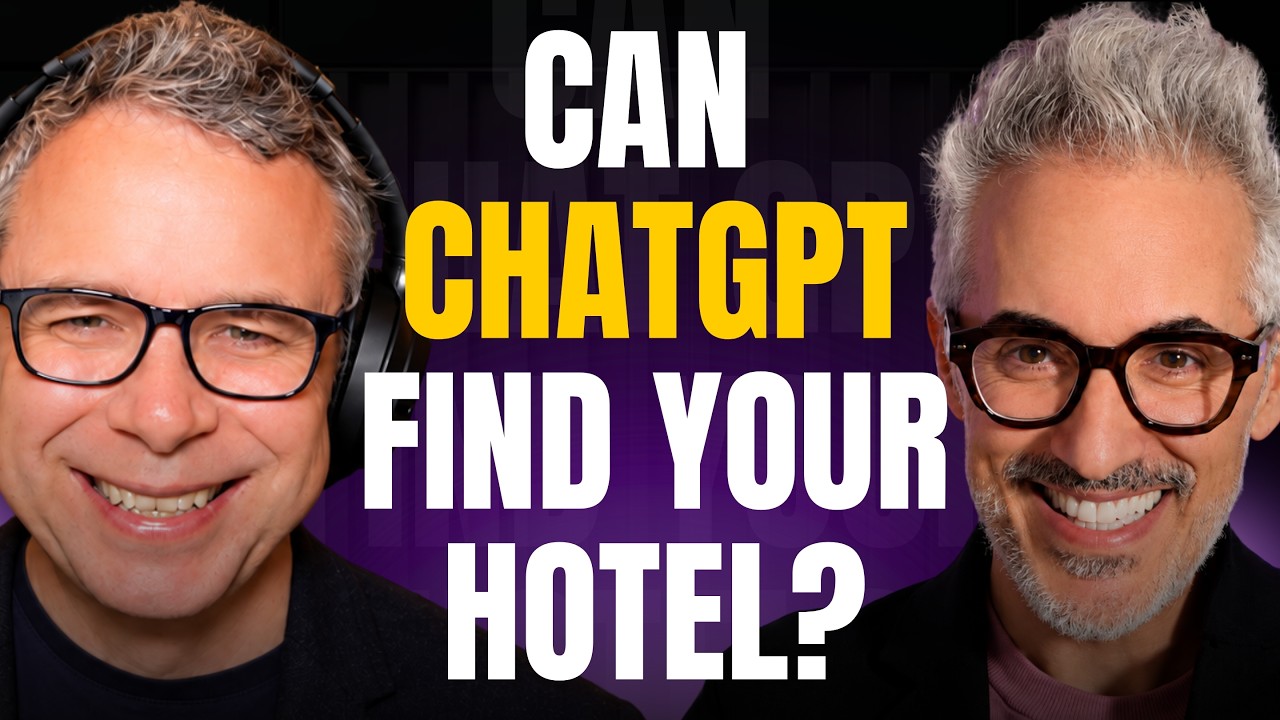
Can ChatGPT Find Your Hotel? Answer Engines, a Fleet of 17 Agents and One Rule Against AI Slop
Hotels have spent a decade capturing billions of pixels of their own spaces, and the AI tools now shaping event bookings can't see any of it. Jascha Kaykas-Wolff, CEO of Visiting Media and veteran of Yahoo, Mozilla, BitTorrent, and Microsoft, unpacks how hospitality businesses can convert immersive property data into content answer engines can actually read, why data ownership is the only durable moat, and how a fleet of 17 agents is quietly transforming a 140 person company.
Show Notes
Jascha Kaykas-Wolff is CEO of Visiting Media, the hospitality sales platform behind TrueTour, which helps properties capture, enrich, and distribute immersive content across the channels that drive event and group bookings. He brings more than 20 years of experience from Yahoo, Microsoft, WebTrends, BitTorrent, and Mozilla, where as CMO he championed consumer data rights and an open internet, a philosophy he has carried directly into hospitality. In conversation with host Alex Brooker, Kaykas-Wolff explains why answer engines like ChatGPT cannot parse 360 degree tours, and how Visiting Media addresses that gap by converting immersive assets into structured written descriptions and conversational FAQs. He describes a system of synthetic buyer personas that interrogate a property's data with hundreds of questions, answered by a council of agents, a process that took one client from invisible to number one in ChatGPT results. He contrasts answer engine optimisation with traditional SEO, arguing that anticipating conversational intent now matters more than keyword authority. On the operational side, he details how company wide chat licences failed to drive real adoption at Visiting Media, and how rebuilding around 17 agents tied to departments, monitored through an HTML dashboard he calls the brain, created genuine workflow change. He closes with a single rule he won't bend on: anyone using an agent to communicate must read and understand the output before it is sent.
Read the takeaways
Can ChatGPT Find Your Hotel?
A hotel can hold billions of pixels of its own ballroom and still be invisible to ChatGPT. This week's guest says his team took one Bay Area property from undiscoverable to first in its region, and…
Read the newsletter issueFull TranscriptClick to expand (12,654 words approx.)
Jascha: I fundamentally believe that each one of us has an opportunity and really an obligation and responsibility to have control and ownership over all the information that's available about us on the internet — like, period, anywhere. This is true for us as consumers, but it's also true for us as businesses. And I think that, for me, is really the lens that I take into this industry. It's like, yes, of course we can be creating great experiences for the buyers of the products that we produce. But fundamentally, it has to be about how do you help a business have total ownership over the data that it collects about its customers? How do you have total ownership of the data—
Alex: Hi, everybody. Welcome to this week's episode of the Travel Tech Podcast. My name is Alex Brooker, and this week's guest is Jascha Kaykas-Wolff. He's the CEO of Visiting Media and has had an illustrious career across a range of Silicon Valley companies like Mozilla, Yahoo, Webtrends, Microsoft, BitTorrent. And he gives his perspective on the hospitality industry, on AI, and actually shares one of the most advanced setups in terms of agents, loops, and how AI has been adopted within his company. This is a good one. I hope you enjoy this conversation.
This is brought to you by Airside Labs. That is airsidelabs.com. And I really hope you enjoy this content. Please keep the feedback coming and do not forget to like and subscribe and follow us on all the main platforms and on LinkedIn, where you can message me directly and pitch to come on and tell your story as well. All right, let's get into it.
Jascha, fantastic to welcome you to the Travel Tech Podcast.
Jascha: Hey, Alex, I really appreciate you taking time with me today.
Alex: No, you're very welcome. I'd love to learn more about your business and your background and get to know you a little bit. Maybe I could just ask you to start by telling us how did you get into the travel industry?
Jascha: Well, listen, I am two and a half years new to the hospitality industry, and I am in love with what I get to do every day. I just have such a romantic view of the industry and have continued to hold onto that, even dealing with the operations that can sometimes be complex running a business. But I just love the industry. I come here as someone who has excitement about the experiences, the theater of what the hospitality industry gets to produce for all of us as end consumers.
But my way of getting here is maybe a little bit untraditional. I spent 20-plus years in what I'd consider to be the infrastructure of the internet, and did that through companies like Yahoo — back when Yahoo started in the late 90s — where I was recruited away to join Microsoft. I was there for several years. I built, with a couple of colleagues, what's called the Microsoft Store, so the whole direct channel for Microsoft. And then spent a good deal of time in what I'd consider startup-y space, but still in this infrastructure world, working for one of the biggest, oldest, first analytics companies in the world, called Webtrends.
And then spent quite a few years thinking about and caring about how people get information, and did that through my CMO roles at a company called BitTorrent, which created the first big internet sharing protocol for content and files generally. And then for about half a decade, I was the CMO for Mozilla, that built the Firefox product, but maybe more importantly is one of the largest protectors of a free and open internet, governed by a not-for-profit and really focused on delivering value to consumers so that you and I can own what information is shared about us.
Through that experience, I started to expand the roles that I had. It was mostly in marketing and product roles, but I moved into oversight for and managing parts of the engineering teams with places like Mozilla. Really got excited about operations globally and had the chance to run a startup in the customer data platform space. Through that, I had some really wonderful introductions across investors that I knew into this world.
My way through here — well, I think I started off saying untraditional, but that's probably actually wrong. It's probably very common, the way that people get involved in the industry — through a person and one person's experience in the industry. So I was introduced to the founder of Visiting Media, a gentleman named Ben Powers.
It was kind of a love-at-first-sight conversation, a great meal, a great conversation — just a person who deeply cares about the effectiveness and successfulness of every single person that exists in this industry. And that kind of excitement about how do you deliver value to an end person, to a consumer, to a buyer, to me is incredibly invigorating. So he and I worked through what it would look like to have me join the organization and help him operationalize all the work that was happening. And through that process, he kind of discovered that he was really excited about doing work that wasn't running the company. And I transitioned into being the CEO in November of last year, 2024 going into 2025. So it's been a really wonderful experience.
I get this very clean view into the space that comes from my experience thinking about how technology gets adopted by consumers and businesses. And now I get to learn about how the industry thinks about caring for guests and buyers — corporate buyers. And I bring all of the tools that I've put together over the last 30 years to bear. It's just an absolute privilege every day.
Alex: It's fantastic. There are some serious company names you're dropping there. They really are the stalwarts and titans of the early internet age. I'd love to hear your perspective — from that background of Mozilla and BitTorrent and Yahoo, early internet — your view on consumer data and the open internet. What are some of your reflections on the hospitality industry when you see it through that lens and coming from that background?
Jascha: Yeah, I think where my perspective lies is that I fundamentally believe that each one of us has an opportunity and really an obligation and responsibility to have control and ownership over all the information that's available about us on the internet — like, period, anywhere. This is true for us as consumers, but it's also true for us as businesses. And I think that, for me, is really the lens that I take into this industry.
It's like, yes, of course we can be creating great experiences for the buyers of the products that we produce. But fundamentally, it has to be about how do you help a business have total ownership over the data that it collects about its customers? How do you have total ownership of the data that you have access to that can create a better experience for your customers, for your guests in particular?
And it's very easy to let that slide for businesses. It's like, I can just outsource the way that we think about data ownership and control to — I don't know, in the world that we operate today — Anthropic or Mistral or ChatGPT or OpenAI. And I think that for me, it really grounds our responsibility to be stewards of the data, so that our customers have access and control and can use it in a way that's respectful of their guests and their buyers.
And that goes into architectural decisions that we make. It goes into hiring decisions that we make. Philosophically, we think that data and access and control should be the domain of the person who is actually producing the data. I laugh a little bit when I say that, but it is so easy to just ignore that and think about the conveniences that are available to us and outsource the decisions to other people and other organizations. And I just don't think that we should be doing that, generally.
Alex: So what does that mean — and I'm jumping straight into it, so we will talk about Visiting Media in a second — I'd love to get your perspective on some of the things happening in the last few weeks and even just the last few months. We have an explosion of different AI travel planners. We have plugins being announced. You can integrate with some of those big names — Claude, ChatGPT, Gemini, or whatever. What's your take on data ownership when those links are going to pop up at some point in the chat flow, or may or may not pop up depending on what that user has typed in when they're looking for something?
Jascha: I think that we absolutely have to understand where the data that we have is being transmitted to, and what data is coming to us to make the decisions that we make. It is so incredibly easy to just take the word of a chat program, as an example, that we're using — because of whatever access to whatever information it has, ours or some other third party's.
I think the punchline here, Alex, is that it's our responsibility to not let things just happen in the background. You have to ask the questions. And that's going to add a little bit more time in the way that we work, the way that we experience things, the way that we're just trying to play around and learn. But that's our obligation and responsibility.
So it's a philosophical perspective more so than a technical one, but I think we can take that philosophy and really put it into play when we talk about what we do on a day-to-day basis. As an end consumer, we should always be questioning what we're asking, what we're choosing to give authentication to and what we're not. And that sounds like — I don't know — it sounds a little bit like, "You kids, stay off my lawn." But it's just a philosophy that operationally I think we have to really hold onto as individuals. And it's the same for business — but really as individuals, that's the line of defense that we have to work with.
Alex: Yeah, I understand. How do you apply that into hospitality and in terms of solving problems for customers of Visiting Media? Well, I guess maybe you could step back a little bit — can you tell me a bit about Visiting Media? Maybe some listeners are familiar with it, but perhaps an overview would be a good grounding place.
Jascha: Absolutely. Perfect, let's start there. So as a business, we've been around for a bit over a decade. We were founded by our founder Ben Powers, and his view was that it is kind of a responsibility for each venue that exists in the world to be able to present exactly who they are and what they do in the absolute best light possible. And the way that he started doing that was thinking about how you bring — a decade-plus ago — what we call immersive experiences directly through to those individual properties.
So you or I, if we're choosing to go to a property anywhere in the world, if we're going to host an event anywhere in the world, we should be able to experience it, see it — everything other than touching it and smelling it, we ought to be able to do. And so he really thought about how do you pioneer bringing some of the early technologies from Google to play, and found a tremendous amount of success. He's evolved the business and we've changed quite a bit from then, but that at its core is where we create the absolute most clear value with all of our customers — helping them be able to present who they are in the absolute best way possible.
We do three things at scale that are pretty interesting in our industry. The first is that we've got one of the largest networks of what I would call data capture specialists anywhere in the world. And this is going to come back to this discussion around data ownership. We have 800-plus individuals who have been trained on and certified to work with the different technologies that we have. A data capture specialist, once a customer chooses to work with us, goes to their venue, their property, whatever it may be, and they capture it with 5K video, and they capture it with LiDAR, and they capture it with different types of other technologies so that that data can then be owned and managed by that business.
Owning and managing that data by itself is not something that we would expect most of our customers to be able to do. So what we do is take that data and enrich it. And this is the second part of what we do that's pretty unique. We take that data and bring it through a pipeline that enhances it so that it represents a specific part of the property really clearly — like a ballroom or a lobby or a spa.
When we take that data and construct it into that particular space, we then present it to our customers so they can present it to their own customers — in a 3D walkthrough, in a drone flythrough, in a multitude of different types of applications. So that data is then cleaned and enriched. And what I mean by cleansing and enriching is that we now — because we have this enormous corpus of data that we've been collecting over the years — are also able to say, okay, this is a ballroom, this is a ballroom that can hold this many people, it has these dimensions, it has these colors. And we're able to extract all that information out and create descriptions about what that space is. This becomes like ground-fact data for the property.
We're then able to clean it in a way that represents the brand guidelines for the parent brand that that particular property is attached to. I'll make this up, but let's say that in all Hyatts, whenever they're presenting one of their luxury properties, they need to make sure that the exit signs are taken out of the view for that immersive experience. I'm making that up — it's not really a thing — but we're able to, through this data enrichment process, actually extract out things that are not brand-safe or brand-appropriate, or enhance things to make them look the way that we want them to.
That data, once it's collected, is then delivered through the third part of what we do that's pretty unique, which is helping our customers distribute that data, that content, those immersive assets in a way that's meaningful for them. We do that in a few different ways. The first is that we've created what we call the Visiting Media platform — all that TrueTour, which was the original name of the offering. That product helps the salespeople that sit inside of a property collect and organize that information so they can respond to RFPs.
Jascha Kaykas-Wolff: So if you, Alex, are reaching out to me and it's my property and you're saying, I want to host an event, you send me an RFP, I'm able to take all that information and that RFP and present you with all of the rich information about my property to you. And I can do that in some really clever tools that are really about sales.
In addition to that, we distribute directly into integrations, into tools like Cvent and your CMS and your PMS and onto your website so that that immersive content, all that data is able to be delivered directly through the end consumer. That may make you as an end consumer, or me, if I'm going to the website to look for maybe a suite or a room that I want to stay in, I can see that now in the purchase experience. The last thing that we do, which is relatively new for us as a business but I think really exciting, is that we actually take all of that information and we make it available so that the ChatGPTs and the Anthropics of the world are able to actually view the information about your property in a way that helps it be simpler for you as a property to make sure that you're discoverable through all these different vehicles.
And the way that we do that is — I'd say fairly unique — in just the way that discovery's happening today, as you were intimating before in our conversation. Like, I may choose, if I'm going to look for a property to host an event at, to go to the website. Maybe I'm going to talk to a travel coordinator, or search on a website, or Google, or what have you. But more and more, I think it's upwards of 90-plus percent of all business travelers that are booking events that are actually going to ChatGPT or Claude first.
The way that they actually look for information is they look for structured data, typically in the form of an FAQ. Like, does this property open at eight in the morning? Does this property have a spa? Does this property allow pets? Does it have carpet versus wood floors because I have allergies? Those FAQs are structured in a way that helps the answer engines find your property.
One thing that the answer engines don't see today in any capacity are actually those rich immersive assets, the ground facts about your property. We convert all that information into a set of FAQs, into structured data that actually helps our properties be discovered by Claude and ChatGPT and Mistral and all the others that are out there. So really those big three things: capture data, enhance that data and make it available, and then distribute it both to the sales organizations, to integrations, and ultimately out to this world of AI discovery. So that's kind of who we are as a business contextually.
Alex Brooker: I see. And as you were talking, you were sort of answering my questions as they were coming up in my own mind, and you were knocking them down and answering them. I was sort of going to lead towards, okay, so how do you make that rich data discoverable inside the chat flow with one of those clients when someone's searching?
Jascha Kaykas-Wolff: Yeah, so let's talk about that process because it's really fascinating. LLMs, which are the underlying driver for a lot of the chat experiences today, didn't exist to really consume visual information. They existed to understand and predict words, right? Like what letters, what words are the highest probability to show up next.
So that's been interesting. It's been around for quite a few years now. Our view was actually that it doesn't have a relationship into the world that our customers are operating in. They operate properties 24-7. They've got thousands, maybe tens of thousands of guests that are looking for them and wanting to experience these properties that they've built out. And the challenge is that they've actually gone out and created all this content through this data capture, but none of that's been available. So how do you convert that? The first option would be maybe LLMs can catch up and figure out how to read this immersive data.
Maybe that'll happen at some point in the future. Maybe it won't. There doesn't seem to be a lot of work happening in this space yet. There's still a lot of work to be done on just understanding written context. So our engineering team — we've got a brilliant engineering team, a really amazing CTO, Eric, who joined us a little bit over a year ago, who's an expert in machine learning models and in LLMs.
His view is actually that we can do a lot of the heavy lifting on behalf of our customers to convert the visual data that we have into something that's machine readable. And so we take all of that data in the ingestion process and we enrich it. I talked about it really briefly before, but that enrichment process is pretty fascinating. It's looking at the billions of pixels that could exist across the 360. It's understanding and interpreting what those pixels are. This is a desk. This is a window. This is a mirror. This is a floor. This is a bridge or a walkway. And then we turn that into actual written language. So we can create these really robust and technically accurate descriptions of all of our properties.
Those descriptions are really what's most critical for the LLMs. But the work can't stop there. And this is what's been really fascinating — the learning from the innovations that our engineering team have done. Just creating the descriptions, creating the metadata isn't enough. And so we've created a process that actually helps our properties take what we call a synthetic persona.
This is an oversimplification, but there are, let's say, two types of buyers that exist in hospitality. One of them is a consumer traveler — maybe there's a budget traveler and a luxury traveler and everything in between. And then on the other side, there is a business buyer, and the business buyer is going to book an event. There maybe is a boutique travel agency that would do that, all the way through to a Fortune 500 corporate planner. So we create personas of each of these different types of persons on behalf of the brands that we work with — the Marriotts and the Hiltons and the Hyatts, et cetera. So they're kind of tuned in, or they can be tuned in, to their product marketing descriptions, the personas.
We then take all of that ground truth that we've interpreted from all of the data that we have, and we have the personas ask questions that would be important to them as buyers. So one of these personas — that could be you as a corporate traveler or corporate planner — would ask hundreds of questions of this property. Can it host a thousand people? Can I do room blocks? Can it do the following things? Can I configure the spaces to do the following things? So it asks all those questions and then we have a council — a set of AI agents that we've built out — that actually takes the questions that are being asked and answers them on behalf of the property. So it's an interpretation of the data.
It's then asking questions of the data based on the personas of the buyers. And then it's answering those questions. Of course, all of this can be adjusted by — and it should be adjusted by — the brands themselves. And so that's something that we work on with our customers using our experience. But that process, that data pipeline, is really critical in being able to express rich visual information in a way that's understandable by the Claudes and the ChatGPTs and the Mistrals of the world.
It's a really interesting academic process to go through, but it has huge practical implications. One of our alpha customers, in the Bay Area where I happen to live, went from not being discoverable in ChatGPT to the number one ranked property in the region on ChatGPT because we converted all of these assets into something that was able to be understood and viewed by the engines themselves. They didn't have to do any additional work, which we thought was pretty amazing.
Alex Brooker: So I mean, that's pretty incredible. So you've included a baked-in sort of discoverability or validation with those personas as part of the process.
Jascha Kaykas-Wolff: That's right. And you really have to.
I mean, you have to, and this is what's so fascinating about the learning in this space — there is so much movement. All of these platforms are developing at such a rapid rate that the idea you can offload the learning loops to your customers is a bit of a farce. So we feel it's our obligation to make it incredibly simple for our customers to be able to get this value.
And it turns out that the way to do that is actually to create our own learning loops, where we're constantly looking at and evaluating what searches are coming back, what queries are coming back, who's ranking well, and then feeding that back into the whole pipeline over and over again. This is, I think, really the backbone of our CTO's background. He built out a customer data platform that was built around a set of dozens of self-tuning ML models. And self-tuning means it's just looking for feedback on whether it's getting the outcome that it wants, and then it just keeps learning and growing and growing. So we do that across thousands and thousands of customers, across a quarter billion assets under management that we have. And it puts us in a pretty unique position to be able to make really significant technological advancements that support our customers, and we think across the industry ultimately.
Alex Brooker: Do you think — I mean, that sounds incredible — do you think that pre-AI, for the actual tools themselves, for building a company, do you think that you could have done this, what you just described, five years ago?
Jascha Kaykas-Wolff: Look, I know definitively it could not have happened five years ago. Definitively. The models now are becoming so much more sophisticated and cost effective in a way that just wasn't possible even six, seven, eight, nine months ago. So the speed at which innovation is happening in industry is — it's maybe a challenge for us as an organization to be able to create repeatable, useful infrastructure that our customers don't have to fiddle with all of the details around.
Alex Brooker: Yeah. I say this because I think this is part of what we're learning as consumers — everything is changing around us all the time. And maybe we're becoming accepting of that. I mean, I think about it — do you use any of those chat products on a daily basis? Like OpenAI or Mistral or all of them?
Jascha Kaykas-Wolff: Claude constantly, for everything — my business, my organizing and everything. And then ChatGPT as a second tool. I do switch occasionally as one gets better than the other, but Claude's the main one at the moment.
Alex Brooker: I think this is exactly what I would find here — you're using Claude daily because Claude's doing what you need right now. But Claude's changing. And it changes frequently. From one version to the next, things are changing incredibly rapidly. And you as a consumer are like, well, I have to figure this out, so I'm just going to keep fiddling with it. And we're kind of building almost like calluses for ourselves — like if you're working out, banging in fence posts on your farm, we're working out these calluses, teaching ourselves that we're just going to have to deal with the fact that these things are changing all the time.
When you're in a business as sophisticated and complicated as running a property — where, as I mentioned, it's a 24-7 operation — there are probably hundreds of employees for a small or mid-sized property. 24-7, three shift changes during the course of the day, one GM, a few operational leaders, a bunch of managers. That level of operational complexity doesn't afford the freedom to deal with building your own calluses, to relearn this thing every couple of weeks.
On top of that, the industry is — and I say this in a positive way — transient. There's a ton of change. You do a great job at a particular property, you like the brand, that brand takes you to another place. You just can't expect that each individual employee in your organization is going to do this work on your behalf. These people are also on their feet all day long for the most part.
Jascha Kaykas-Wolff: The things I think we take for granted as information workers — and I'll broadly put you and I in that bucket — you just can't apply that when you're working with properties. And so we have to think about what we do to make all of the changes that are taking place in industry almost opaque to the customers that we're working with. The tools that we've used to build out the experience that we've built, those are going to continue to evolve. It's going to make it maybe easier for us to deliver things faster to customers, maybe less expensive for our customers, and we care about that as well. But the reality is that the tools didn't exist to do this half a year ago. They're going to change. But us as a business, we can't make it something that our customers have to deal with. We just have to constantly keep consistent, good delivery to our customers front of mind, and make all the back-of-house stuff abstracted away from them so they don't ever have to deal with it. And things are going to change a lot — so much in the next month, two months, three months, six months.
Alex Brooker: Every two weeks. I mean, it is a bit crazy right now.
Jascha Kaykas-Wolff: Exactly. Like three weeks ago there was a Thursday or Friday where ChatGPT dropped something, Cerebras dropped two different models, Claude updated one of their models, and I think the Kimi models were launched. It was just — there's so many things happening. You're like, how do you keep track of this? How could you be expected to keep track of this?
Alex Brooker: Well, I mean, I live and breathe this stuff for the day job and I feel like I'm behind and can't keep up, right? Yeah. What does your infrastructure look like? Are you using the chat tools themselves? Are you experimenting with different models? Like, what's your system?
Jascha Kaykas-Wolff: So I use Claude Code to automate big parts of my business and my work — coding, building apps and prototypes. And then I have a home AI desktop setup where I train small models and build things locally as well.
Alex Brooker: So you're using self-tuning models. So you're using like the Ollamas and things like that?
Jascha Kaykas-Wolff: Yeah, yep. Some locally tuned models, tuned embedding models, to get very, very deep into the tech locally, but then Claude Code as well.
Alex Brooker: What do you feel like has been the biggest advance for you individually? Like, what's been the aha moment — like, oh yeah, this is exactly what I should be doing?
Alex Brooker: This has made an enormous difference for me. I'm super curious. I'm happy to share with you what my system looks like as well, but I'm very curious about what's worked particularly well for you. Jascha, this is the podcast host background coming out in you, sir. I think you've turned the tables on me already.
So what's the biggest unlock, I think... okay, maybe two things. My background is in engineering, software engineering, data, but that was quite a long time ago. But I retrained and knocked the rust off the chains and I'm fully back into coding and building again. So Claude Code, Open Code, Codex — those tools have unlocked that for me massively. And then knowledge work-wise, automating things around email and particularly document production. So in aviation and travel, we love our 50-page PDFs. And so dealing with documents and using AI in a responsible way — not creating huge tranches of content, just using LLMs, but actually using them for what they're best at: processing text and documents together to say, okay, bring these five things together and help me understand what's going on. I think those are the two big things for me. But I'll turn the tables back to you, Jascha. As a CEO, what's your setup?
Jascha Kaykas-Wolff: So I have a fleet of agents that I've built out over the course of the last year or so. I started experimenting first with Open Claude and then kind of brought on board the Hermes Nous harness agents as well. Right now I think — I'm looking side corner at my Mac Studio sitting in the office where a lot of these live.
There are about 17 agents that exist, split into three different groups.
The first is a set of personal agents. I use a model garden and different harnesses to make sure that I've got diversity in the way that we work. So my personal agents — one of them is built on Open Claude. It has a model garden that has access to pretty much everything from Anthropic to Moonshot, you name it. And those are built around the tools that it's actually deploying work against. Then it's got a partner that it works with that's built on Hermes. The reason that I like to keep my personal agents on two different systems is that I think they're advancing so quickly — both of them as open source projects — that the benefits that come from either of the two may work out better over time. And I'm not willing to make a bet that one of them is going to be better than the other yet.
So those two exist. They've got a partner that's a Hermes agent that is effectively the substrate for the fleet. Those three are the ones I interact with most frequently. Underneath that — and this is about the deployment inside the company — we've been thinking about and experimenting with how do you get great adoption across a company? We're 140-plus people, and there are some really sophisticated engineers and there are some people who are not deeply enthralled with the technology and are really focused on interfacing with our customers.
So maybe this is interesting for the listeners too. We started out a couple of years ago thinking, well, let's just give everyone access to the tools — licenses to ChatGPT or Claude or what have you. We didn't really see adoption take place in a way that benefited individuals or really the business overall. And so we stepped back from that a little bit and then redeployed agents very specifically for key executives who are responsible for each department. So in this agent fleet, there are agents that are docked directly to our SVP of Sales, our Head of People, our Head of CX, and our COO.
Each one of those agents has a set of tools built very specifically for them — skills that are built for them. But they exist inside a fleet, and they exist on a graph. And that graph allows each of them to talk to each other. So each of the department heads work together really closely, they're able to use all the same sets of tools, and they have access to the same data.
And then on top of that, those get deployed down to individuals inside the organization. So my fleet is effectively a fleet that is deployed into the company that I'm responsible for as the person who thinks about upkeep for it. I'm constantly looking for what are new skills, what are new ways to improve the fleet by looking at the graph. How do we think about new models that get introduced? I use the BBE infrastructure to do handoffs from agents into the core infrastructure and code.
And then I've got some specialized agents that sit in the company that are not docked to a specific executive in their department, but they are really great coding partners. I've got an agent that has been built out that understands our codebase and the way that our engineering team works, and it's one of the highest-producing developers inside of the company. It can work both directly with engineers and with our DevSec team, but also convert PRDs from the product team into work the engineering team can work with.
Alex Brooker: This is wild. This is incredible.
Jascha Kaykas-Wolff: I'll tell you, one thing that's really interesting that I would highly recommend — because the conversational workflow is such an unlock for me personally. I think back to a manager at Microsoft who was really influential in my career. I had this one conversation with him when I was writing a presentation — a brief before an exec meeting I was going into — and I was stuck. He said, listen, it's really common for all of us to have writer's block. Very rarely do you have talking block. This was 15-plus years ago, and he introduced me to this program called Dragon Speaking, a dictation tool. I'd been using that for a long time, and I've kind of transitioned that way of working into this world.
The way that I do it now is I use a tool called Willow — Willow Voice. It just works for me. I work on a Mac, it works pretty well. I just talk through Willow into these different agents all day long. And that has been a huge unlock for me to be able to produce more useful work overall.
But the big, big unlock was having a conversation around — I was really struggling with the way that information was being presented back to me. Markdown files — I'm not a native engineer like you, so this idea that all this technical infrastructure is getting created and this Markdown language is being used to represent the work that we're working on didn't work for me. So I asked the system to help me convert all of the work that we're doing into effectively an HTML brain. And so I have a microsite that shows me the fleet health, can help me dig into different nodes and fleets on the graph, has the inbox that the agents talk to each other in so I can see what's happening there, and has all the loops that we're working in — if a loop is broken.
But that conversion of all of the stuff that is being deployed onto your computer or written onto your computer — stuff that's just not really human readable — converting that into an experience space has honestly been the biggest unlock for me. And one of the areas that I would highly invest anyone listening in: I ask you to consider talking to your Claude, talking to whoever, and saying, look, I need to visualize what you're doing with me better, and then work that out together. I promise you that will be one of the biggest unlocks for most people who are non-technical.
Alex Brooker: That's fantastic. I love that as a prompt example: visualize what you are doing with me — across our chats, across the agents, across the history of that. Because a lot of people have built up memories and chat history, so that could be giving some really interesting results, right? And it's such a — I mean, many of us are very visual by nature, and it makes such a big difference to convert everything that we're doing into something that is just suited to the way that we operate. It seems so simple to say, but could create something really fascinating.
So given all of that, Jascha — that setup sounds incredible and very, very sophisticated and advanced — let's talk about what you think still has to be human. You mentioned RFPs and a process that some customers go through, where maybe they get sent a big PDF and they've got to do a big response. It feels very old school. Let's create an RFP response document that's 25 pages, drag in images, make diagrams — it just sounds like ancient history. But given that context, and perhaps with your insight as a CEO running a business, which elements do you feel have to remain uniquely human as of today?
Jascha Kaykas-Wolff: Well, as of today, I think there's a really simple rule to introduce — both for yourself personally and as a company. I think we really have to be mindful of this. So I'll describe maybe the problem or the challenge that we were operating against.
We started to see, as these agents became more embedded in the way that we worked and had a relationship into the work that individuals were doing with Claude or GPT, an enormous increase in the output of written documents from across the company. And I'll call it what it is — a lot of it was AI slop.
I'm looking for a recommendation for a business decision that we're making. Come to the meeting prepared to discuss it, send a pre-read in advance — very normal thing that you would do in most businesses. And you'd get a 30-page document full of Claudisms, or "Claude-ish," I think is the term. And you're just like — we got so much of this stuff across the organization, and I'm like, this is useless. We've gotten to a point where we've just bombarded each other with stuff that doesn't make sense.
And so we introduced — there's really one rule. There are kind of two. One of them is: don't burn all your credits, be mindful of your spending. But the second rule is really simple, and it's built on the appreciation, understanding, and commitment that we are going to be using AI as partners to work with more and more and more. So that's just going to be the case. We're not going to stop it, we're going to continue to encourage it. So in response to that, the one rule is: if and when you are using an agent to produce content and communicate on your behalf, your one responsibility — the one rule — is you have to read the output before you send it to someone else.
And that is so dramatically simple. And it's also a new mechanism that you have to put into any organization. That says, hey Alex, I'm going to have my agent, Nova, send you a report or do some work with you. What this rule means is that I'm not going to have it send something directly to you until I have read it myself. And if I read it and I don't understand it, or it's saying things I don't quite grasp yet, I have to have enough comprehension to be able to have a conversation with you. So that when you get it from my agent and you and I talk, I'm not staring at you blankly going, well, I've gotta read this thing too.
It's a very simple human interaction. I think this is the answer to the question that you asked — what is necessary, appropriate, or will be for the foreseeable future while we're using AI in an industry like hospitality. The simple rule is: AI should be doing so much more work with us across all different functions of hospitality. However, a person who interacts with another person has to be the arbiter of what is sent.
So it's not a check for risk. It's a check for comprehension. It's a check for brand experience. It's a check for experience overall. I still think — and this should be true forever, or for a very long time, or for a while; never say never — that a human needs to be the arbiter of what is being sent. And I think that puts a question mark into some of the adoption and operations that I'm seeing across a lot of properties that I work with.
There's a comfort and a confidence in being able to deploy a tool from the GM down that interacts with guests, where there's an assumption that it's going to hallucinate and I'll figure that out over time. I don't think we should be doing that in businesses. I think we should be saying, cool, let's train this model that's going to interact with customers — maybe respond to their requests by text in the app — but somebody needs to review that stuff.
Continuity is incredibly important because it goes all the way back to the beginning. We should all feel privileged to work in this industry. It's amazing. We produce beautiful experiences that can be life-altering for our guests, for our buyers. And if we appreciate the theater that we get to produce, then we're not going to outsource that last interaction — or the quality of the interaction — to something or someone else. We're going to care about that. I think we should.
Alex Brooker: And how much of that automation — or lack of automation, using a human touch and human relationships — comes into the way that you address the market or reach out to your customers? Where do you see the balance landing on that side?
Jascha Kaykas-Wolff: Well, I mean — I'm not here to promote our company or our products, but I can use an example from last week that really represents exactly what you're getting at. How can we acknowledge the speed of innovation, the excitement, the power that AI broadly can produce — or work with us to produce something powerful for our customers — while also respecting this idea that there should be a person who is the arbiter of the experience?
Last week we introduced a few different things, but maybe the most relevant in this discussion — we introduced something called AI Staging.
A very typical sales scenario looks like the following. You reach out to me with an RFP. You're going to host an event, it's for 1,000 people, you need to block out all of the rooms in the house for a couple of days.
Jascha Kaykas-Wolff: So I'm going to respond back to your request in a way that can help you visualize what this experience for you and for your guests or your company is going to be inside of my property.
The way that we do that historically — we broadly, the industry — is that we've gone out and we've captured data about the property. We've produced 3D walkthroughs and 360s and so on and so forth. We've got great tear sheets and artistic photography.
But we do that at a big cost to ourselves. And the cost comes not just down to money, it comes down to time. Let's say I work at a property that is booked at 90% capacity, 100% of the year, like a big resort in Hawaii. When I'm coming out to capture that data, when that's happening in my property, I can't take a bunch of rooms offline. It's too expensive for me. I can't inconvenience my guests. So I do my data captures, my shoots at maybe six in the morning. And maybe it rained the night before because I can't control the weather. So the things that I'm responding with represent my property incredibly well, but they're built around the constraints and the costs of actually doing that data capture first.
So AI staging for us was this idea that — hey, I'll use that Hawaii example again. You want to do an event. It's a wedding for a thousand people. It is going to be at the golden hour because that's the time that you want it in Hawaii. It's like right when the sun kind of crests and before it has this little pop of pink and yellow before it drops down to the horizon. But that's not the photos. That's not the data that we captured.
AI staging allows for me, as I'm responding to the RFP, to say, hey, Alex wants to have this event. It's a wedding. It's going to be on the water. Here's the space that we're going to host it in. We'd like to show it dressed for a formal wedding. We'd like to show it at 6:30 PM Hawaii Standard Time. That means the sky is going to have the following kind of dynamics to it. And I now can, as the salesperson responding to you, make that — not just the image like you do in ChatGPT — clear. I can take all the ground-truth facts built into that data in that 360, and I can stage that for you. This is not diagramming. It's not CGI. It is a very simple way for me to be the arbiter of the experience that you're going to get, using the tooling that we've built, in a way that represents the property accurately but also gives you the vision of the experience that you're trying to produce.
So that's the way that I think this industry can really take advantage of AI and produce better experiences that are going to help me as a business perform better, but for you as a buyer, really see what you're going to get. And I think that's kind of the magic of the industry. We can create these beautiful events for individuals, for businesses, and now as a seller or as a marketer, I can show you what that's probably going to look like, and I can let you walk through and experience it — which even months ago, this wasn't possible. This is really cutting, bleeding-edge technology, so to speak.
Alex Brooker: Yeah, I was just thinking in my mind as you were talking and describing it — okay, have I seen this before? Where have I seen this? And it's only fairly recently that I think the tech is good enough to provide high enough quality.
Jascha Kaykas-Wolff: It's really fascinating too. As we were going through the process of building out these capabilities, here's what our learnings were. Have you gone into Claude or ChatGPT and said, here's a picture of me, make me look like a cat? I mean, I'm being facetious, but we've asked tools to do things like make my background better, do whatever.
Things don't always look right, right? Spatially, things don't look right. Maybe the head of the person is off size. Things don't practically look real. I'd call that broadly a safety issue — it's like, when we're playing around, we can have things that aren't safe because they don't represent exactly what's happening in a meaningful way. We're also talking about flat photographs, which may be a lot of pixels, but it's something that we snap with our phone or with a camera. What we're talking about here is a 360 that's a data capture with billions of pixels, enormous in size, representing an actual physical space.
As we've built out this capability, what we learned is we actually have to lock down all of the safety constraints associated with the space. Like, hey, when you're creating an event for this Hawaii event and you're doing the AI staging for it, you can't put people on top of the water. Oh, there's a fire pit — you can't have the fire pit exploding out to the right. The fire's got to be contained. The chairs actually can't sit on top of the fire and they can't be in the water. Those are really simple things to say out loud, but we had to learn how to teach our models that this is actually the ground-truth fact. So it's a really, really interesting world. We're also doing this on top of 360s, which are not flat photographs. So it's like, what happens when I see the back of my head as I'm scanning around this picture?
The sophistication is quite high, but it's an absolute perfect representation of exactly the way that you framed the question. It's like, what can and what is happening? What are the unique things that you're learning right now that make what we're doing in the marketplace distinct?
Alex Brooker: It sounds fascinating. It's a slight gear change, but I wanted to come back to the current consumer experience — or even that corporate event planner. If they go straight to ChatGPT or Claude or Gemini or Le Chat —
Jascha Kaykas-Wolff: Yeah. In France.
Alex Brooker: — and they type in recommendations near me. I'm in San Francisco, or I'm south of London, or on the south coast of England where I am. I'm running an event for a thousand people. What could I find? How do you link that event to the beautiful, enriched, authoritative, grounded data set that you create for your clients?
Jascha Kaykas-Wolff: This really goes back to that walkthrough I was giving earlier — once you capture that data, you have to convert it into multiple forms. One form may be a 360 that gets embedded on your website or a 3D walkthrough. The other is we need all of the metadata around that visual.
And that metadata around the visual is actually the jumping-off point to make it possible for ChatGPT, Claude, Perplexity, et cetera, to be able to find that property. So the real work of the work is converting all of that rich data in the 360 into something that is actually readable.
And then to make sure that ChatGPT finds you, what we have to try and do is predict the questions that are being asked and then answer them in advance. This is the different dynamic between AEO and GEO — the terms of art for optimising agentic answer engines.
First there's SEO, which is how you get discovered on Google. SEO is about structured data and it's about the strength and authority of that data, meaning multiple people have referenced my website and there are big publications like MSN or MSNBC, or whatever the news outlet may be, that give my content — that structured data — credibility when someone is searching for something on Google and it happens to be referenced there.
AEO and GEO, they're looking for answers. And the answers are to questions that you and I might ask, like the discussion that we're having right now. It's not Boolean. It's not "property, thousand people, Berkeley, California." We're asking questions more like what I'm saying right now, with filler words and all.
It's like, I think I'm looking for something for about a thousand people. It's going to be a corporate event, and I think I want to do a pool party. And maybe there are some good restaurants close by that aren't Michelin star but are Michelin Bib Gourmand, and maybe they can host 500 people because I have to do like three of these things. I'm asking this very free-form question the way that conversations happen.
So we have to figure out, as properties, as hoteliers, as anyone in this industry — and really any industry — how do I predict what the questions are going to be for which my property or my business should be the answer? And then we have to effectively write those questions and answers in a way that Perplexity, Claude, and ChatGPT can find them.
We do a lot of that work. Properties are doing this also, but they're not doing it with what we consider to be one of the best assets they have, which are these wildly rich, ground-truth 360 walkthroughs of their properties. So why not use that data in addition to whatever else you're doing? We just take care of all of it for you, so that the output is: now you have all this rich data with all these rich descriptions, and all these questions and answers that are related to your buyers — consumer buyers, guests, travellers, and business buyers. That kind of pipeline is something that I think many industries are going to have to think about. How do you continue to grow and adapt?
Alex Brooker: I mean, it's fantastic, Jascha. Given all of that — and this has been an extremely information-dense, high-quality podcast so far, it's been incredible — but given everything we've talked about, what do you think is coming next? What can we look forward to in the next few months? Let's just stick to months because things are moving so fast. What's on the horizon for you?
Jascha Kaykas-Wolff: Well, look, here's what I mean. I talked about my personal setup and the one that we use in the company, and that's about building agents. The kind of infrastructure that I think all of us as individuals need to understand is that we've been taught how to interface with a chat through something called a prompt. But a prompt — we can write better. How do you get a prompt to be written better?
Once you learn that, you have to next learn what a loop is. A loop is repeating a well-written prompt at some frequency so that you get a repeated set of answers and you can see the change, the diff, over time. On top of a prompt into a loop, there's a concept called a harness. A harness is basically teaching the loop what's accurate, what's true, what isn't true, and identifying if it's working properly or not.
That kind of chat-prompt to loop to harness progression is something I think we all have to understand, because what's happening right now — and we're seeing it advance dramatically — is the addition of the agent, which is a set of harnesses and a set of loops. We're using Hermes and OpenClaw in our company for our operations. But in the last four weeks, we've seen Meta introduce new tools, we've seen OpenAI introduce new things, and in the Bay Area we've got a startup that is incredibly buzzy called Instinct, which is only available via SMS through iMessage. I'm using Claude Duet, which is in alpha right now — I got it on TestFlight on my phone just last week.
So what am I talking about here? What's going to be happening over the next several months is that we as consumers and as businesses are going to get inundated with this idea of agents. What can an agent do for us? What should it do for us? We have some metaphors of what that looks like — like, oh, there's this thing that's always on that I can chat to. But agents have so much more capability. I say this having used OpenClaw and Hermes for a while now. They can act on your behalf in ways that I think are a little bit mind-blowing. The aha moments are so dramatic for us as consumers. There's so much ground for us to explore over the course of the next several months.
I think this is where all of the energy is going to be in industries related to AI. And the byproduct of that is we as businesses are going to be thinking about what we can do with agents that support our customers differently. We have an early alpha of an agent that's effectively another salesperson on your team. And it's not to replace salespeople — it's like, how do I help the sales team be better? How do I verify that RFPs coming in are being sent from legitimate sources and are quality leads?
So this idea of agents is going to become so much more prevalent.
I oftentimes in conversations like this — which I'm having a bunch of fun with, I appreciate you having me here — it's easy to forget how far out in front we are in this industry as consumers and users of the tools being produced. If we look at the spread of adoption, it's like a fraction of a percentage of people who are using super advanced models with paid subscriptions at the highest tiers. It's a smaller percentage of that who are using agents. I know we'll see adoption because consumer companies like Meta have huge distribution.
But we're way at the front end. Generally speaking, most consumers are barely using chat tools like ChatGPT. So we will see, I think, a frenzy in industries around using agents, but consumer adoption is going to lag. That's where I think all of our heads are going to be over the course of the next several months. That's my prediction.
Alex Brooker: That's super interesting. So the leading edge may be those consumer buyers who are at least starting to use the first chat prompt, and they will start to want to book things and take action based on that prompt. Whereas in the corporate world, big organisations are still on the free version of Copilot where you can barely —
No shade on Microsoft, but the entry-level Copilot is not where the most exciting things are happening.
And so that adoption lag is going to be different based on who's buying.
Jascha Kaykas-Wolff: Completely, completely. And so I think we have to consider what is the constituency that we sell to and service, and what value can be added into their experience on a daily basis. It's going to come from agents — ultimately it will come from agents. So that's where attention is going to be for a while.
Alex Brooker: I totally agree. So even at that cutting edge — and it's a slightly challenging question — we're seeing some software companies have their products reverse-engineered or cloned, or at least attempted, with some of these tools being so advanced. I'd love to understand your perspective on that.
Alex Brooker: The moat — what's the moat in hospitality? I think I know part of what your answer might be, but I'd love to hear your expression of where that is.
Jascha Kaykas-Wolff: I think it rolls back to the beginning of our conversation. I think that data, the ownership of our data, is where our moat comes from. Content — that's where our moat comes from. Not to say content like blog posts and things like that, but it's like, what's going to differentiate us over time? These tools, AI, the systems are going to get better and better and better, and more sophisticated and less expensive, higher processing power. That's all coming, and it's not going to slow down for a while, until economically things change. But it's just going to keep going.
So how do I protect my business? I protect my business by collecting, creating, and organizing data in a way that's really distinct and unique to me.
Alex Brooker: That's a very simple answer. It's deeply true. But I also think this has always been true in industry. There was a user experience need that I think drove a lot of industry adoption of software as a service in particular through the aughts.
Jascha Kaykas-Wolff: A little bit out of the aughts, but the reality is that the data underneath is the thing that's always created value. If any organization you've ever been in has used Salesforce, they probably had issues with it, and the issues aren't with the Salesforce software — it's fine. Maybe even good in some cases. But the issue is always that the data you're sitting on top of is in a disaster state.
So for us as businesses, we can be thinking about: am I collecting the right data? Am I organizing it in a way that is meaningful? Is that data allowing me to produce more efficiency for my business that's going to decrease bottom-line costs? Or is it going to help me create efficiencies that are going to help me grow the top line of the business? Data is at the center of everything moving forward, and it should be. That should be the thing that we care about protecting — it's the moat that we produce for our businesses.
Alex Brooker: Yeah, I totally agree. My prediction was going to be data, but also distribution, and still execution. In the way you've described how your business is set up — in terms of an extremely advanced deployment and adoption of AI internally — I haven't heard any other guest talk in this way about how they've adopted AI in their organization. You seem to be certainly on the leading edge of productivity.
Jascha Kaykas-Wolff: I don't think that's unique, though. I guess that's why I go back to saying it really does come down to: is the data meaningful and interesting that you're collecting? Is the content that you're producing and collecting interesting?
Because we can always find different operators. My board could say, hey, we need a different CEO because we need one who's focused on X, Y, and Z and is really good at that, or we need a new head of sales, or whatever. People can come in and out of businesses — any position can be changed over. Maybe that person or that part of the organization operates a little bit better because of their experience, their insights, the way that they work with the team. But the data is the moat. The content is the moat.
In my career, I don't think I've ever worked for an organization that's had as strong a product-market fit as this business did, and I would never take credit for it — it's what our founder created. The need is there, it's very clear, it's a very simple value proposition. So my responsibility and job as a steward of the business has been: how do we take the thing that this person and the team has built out over the last decade, which is an enormous corpus of data, and really use that in a way that can better benefit the customers that we have, while at the same time helping us be as protected as we can be as a business — and use that to our advantage versus thinking about it as being risk averse.
Alex Brooker: I totally get it. And listen, Jascha, this has been so interesting. It's been so much fun learning about you, getting to know you, and learning about your company. How can people reach out to you? How can they find your business online?
Jascha Kaykas-Wolff: I presume there's a website?
Alex Brooker: Yeah.
Jascha Kaykas-Wolff: There's a website — visitingmedia.com. That's us. Check it out, do whatever. And always feel free to connect with me on LinkedIn if any of the listeners make it all the way to the end and think, oh, that's fascinating, I'd like to follow up on that. Just connect with me on LinkedIn. My handle is K-K-S-K-A-Y-K-A-S — the first part of my last name, pretty much everywhere. So just LinkedIn, KKS — you can find me there.
Always feel free to reach out, always happy to chat. Part of what is exciting right now is that I just get to learn every day, all day long. I have so much fun in that mode right now. And one of the best ways to learn is by having people ask questions and being able to brainstorm with them. So I highly encourage it — it's not a flaccid comment. I'd love for more people to reach out and let's have more conversations about what they're doing in their industry, technical things, projects that they're working on. That's a blast for me.
Alex Brooker: Fantastic. Well, thank you very much for recording this conversation with me on the Travel Tech Pod. And I hope one day I can reach that quarter-billion subscribers that you achieved just a few years ago. Was it the SideQuest podcast?
Jascha Kaykas-Wolff: SideQuest, yeah — 250,000 subscribers, a podcast of my friend's. But yeah, one day. Things always grow sometimes when you least expect it, which makes it a lot of fun. I really appreciate you having me here. It's lovely to meet you — big fan, appreciate the work that you're doing here.
Alex Brooker: No, thanks, man. That's awesome. All right.
Ep 38: Who Can Still Design a Plane?
Ep 40: Real Travelers, Real Footage, Four Times the Clicks
Related episodes
Every episode, in your inbox
One email per Travel Tech Podcast episode: the conversation, the key takeaways and the use cases worth building in aviation and travel AI.
Give your agent aviation tools
General assistants guess at aviation codes and get them wrong. Agent Tools give Claude, ChatGPT or your own agent checked answers instead. Free plan, no card.
Connect your agentAbout the Travel Tech Podcast
Hosted by Alex Brooker, founder of Airside Labs, the Travel Tech Podcast features authentic long-form conversations with leaders, innovators, and startup founders shaping the future of aviation and travel technology. No scripts, no sponsors, no sales pitches — just real conversations about building technology that matters.
Have a story from travel or aviation tech? Come on as a guest.