
Every episode, in your inbox
One email per Travel Tech Podcast episode: the conversation, the key takeaways and the use cases worth building in aviation and travel AI.
Real Travelers, Real Footage, Four Times the Clicks
Your passengers are already filming the trip, and the brands collecting that footage will know far more than what was booked. Sally Bunnell, CEO and founder of NaviSavi, unpacks how a library of 250,000 user generated travel videos is outperforming branded and AI generated content, why authentic footage earns four times the clicks, and how airlines can trade miles for passenger video to unlock behavioural data no transaction record can capture.
Show Notes
Sally Bunnell is the CEO and founder of NaviSavi, a travel video platform she launched in 2017 that has since built a library of roughly 250,000 user generated travel videos. Before NaviSavi, Sally studied broadcast journalism and marketing at the University of Nebraska-Lincoln, interned at the Late Show with David Letterman, and spent eleven years directing video content at a record label including Kidz Bop productions. NaviSavi went through Techstars and won Startup of the Year at the World Aviation Festival, the first of four competition titles in a row. In this conversation with host Alex Brooker, Sally explains how NaviSavi licenses its UGC library to hotels, tourism boards, airlines and loyalty programmes, embedding videos directly on partner websites and making that content bookable with direct purchase links. Studies Sally cites show user generated travel video earns roughly four times the clicks of branded content, and a partner study across hundreds of websites found spend rose by approximately $100 for each video watched before booking. She details how airlines can offer miles in exchange for passenger trip footage, gaining first person behavioural data that transaction records never surface, while AI generated destination video risks eroding trust the moment reality fails to match the render. Sally also covers the enterprise sales cycles of two and a half years that followed her first aviation festival meetings, the departmental ownership problem that stalls airline deals when video spans marketing, loyalty, product and inflight entertainment simultaneously, and how a payment scheme of $1 per video attracted fraudulent uploads until NaviSavi added an AI screening layer before human review.
Read the takeaways
Real Travelers, Real Footage, Four Times the Clicks
Most travel video pitches I hear end at the Instagram feed. This one ends at the loyalty ledger, the hotel checkout page and the seatback map, from a founder who pitched bookable travel video to TV…
Read the newsletter issueFull TranscriptClick to expand (7,320 words approx.)
Alex Brooker: Hey everybody, welcome to this week's episode of the Travel Tech Podcast. My name is Alex Brooker and this week's guest is Sally Bunnell. She is the CEO and founder of NaviSavi, an interesting company that's doing great things with user-generated content and video in a way you might not expect. I hope you enjoy this conversation and please don't forget to like and subscribe. It really helps out the channel and keep your feedback coming. With that, let's get into the conversation.
Sally Bunnell, welcome to the Travel Tech Podcast.
Sally Bunnell: Yeah, thanks for having me.
Alex Brooker: You're very welcome. So it seems like only yesterday we were in Lisbon at the World Aviation Festival, and it's only just a few short weeks ago, right?
Sally Bunnell: Yes. Well, I definitely recognise it because the weather's drastically changed since leaving Lisbon. So it's all sweaters now.
Alex Brooker: Sweater weather is what it became very quickly.
Sally Bunnell: Exactly.
Alex Brooker: A bit different to the low 20s in centigrade, at least, in Lisbon, right? It was nice. I was wearing flip-flops.
Sally Bunnell: Came back to the UK and it was long gone, that mission. So it was sweaters while I was at the airport.
Alex Brooker: Yeah, absolutely. Well, the reason we were there was to talk about aviation stuff and aviation business. And I think it was only a few years previously at a previous WAF that you won Startup of the Year, right? Is that correct?
Sally Bunnell: You're right. That was probably two years ago now, 2024.
Alex Brooker: What year is it now? Anyway, yeah, 2024.
Sally Bunnell: I'd been attending the World Aviation Festival for several years before that. They had pop-ups in Singapore, in Miami, and then between Amsterdam and Lisbon. So I'd attended Lisbon and then all the others around that time, and then went back to Amsterdam. And I thought, you know what, I saw people pitching on stage at every one — how do I get to be on stage? So I was giving my little presentation every day, the one they give you when you're one of the startups. And, yep, it worked out perfectly. They put me up on stage in cold Amsterdam that year and I came out the winner.
So it was actually a very good year for us because that really kicked off a four-peat startup of the year winning streak. We'd won at Travel Massive Innovation Pitch Night, then won at the World Aviation Festival Travel Innovation Summit for Startup of the Year, and then I won the Traverse Creator Award for Person of the Year. So we've won quite a few titles. It was really the catalyst for our success, I guess.
Alex Brooker: Yeah. But before I ask you to talk about your business and your background, just on those awards — what happens? Because we see those awards every year with these different companies coming up. What happens sort of immediately afterwards? Do customers line around the block to buy the product?
Sally Bunnell: It's not that easy, let me tell you. You get a lot of publicity, but getting clients takes not just one meeting — it takes multiple meetings. And especially in the airlines specifically, a lot of those relationships that I started at the Singapore World Aviation Festival were two and a half years later until they became a client. So it's like you're playing the long haul game. And I think a lot of those businesses attending are there to see what's really coming up and what is the wave of the future, so it's been great for brand awareness.
It's also done us quite well in terms of putting us on the right stage. We were also a part of the World Cup of Startups, which was a worldwide competition in which we got second place in New York. And so having those kinds of opportunities on a big stage that wasn't specific to travel — I think that's been quite important. We did one of the San Francisco pitch competitions and won as well. It was more about getting out to different people and different audiences and realising how much they don't know about travel and the technology that can supplement it.
So it's definitely been a very good thing — being on stage, garnering that attention, getting the awards, and then really starting to build stable relationships out of that for the long haul.
Alex Brooker: So what's the balance between those relationships where they get to know you as a founder and a person, compared to the corporate brand or product-market fit? What's that balance like in aviation?
Sally Bunnell: As a startup, you have to be able to walk into a large-scale enterprise and say you're a startup because you can move quick and nimble and at a discounted price. But you also have to prove that you can still work with the big guys. We might be small and mighty, but we will be here in six months or a year — it's not just a fly-by-night kind of company. So I think that was something that did take a little bit of trust with big clients, and that's part of going and attending events — I'm still here, I'm still here, I'm a startup.
I started the basis of this business in 2017, so it's almost been 10 years. I've lived through a pandemic. I've lived through the worst possible fundraising times. Just being able to say we're still here — a lot of my clients, and even friends now, have just said the fact that you've been able to wade through the storm is part of the battle as a startup.
So right now we're really at a point where we're seeing those enterprise partnerships finally start to come together. We officially came out in the market as B2C in 2021, but our B2B offering didn't even launch until maybe less than two years ago. So it's definitely been a slow burn, but we're showing them that we're here, still capable, and continuing to grow — our library, our assets, and our product offerings as well.
And the nice part is a lot of these startup competitions invite you back and give you a booth the next year. So they give you a chance to come back, talk on stage about how your company has advanced in the last year, showcase your products, and not have to use your startup budget on it. So, yeah, it's been a really good thing. We definitely hit a lot of that circuit for a good year, and now we've kind of sat back and said, all right, I don't have to be at everything all the time — now let's be very strategic about what we attend and who the right partners are at the right places.
Alex Brooker: Is that still in aviation, or is that more focused on tourism boards, or putting it all together?
Sally Bunnell: It's a bit of a spray and pray as a startup — who is going to be our next client? But it could come from anywhere. And especially because we're in video, video touches every aspect of travel and every travel business. It goes from social media to website embedment. We look at itinerary planning. We see loyalty, where people can be uploading videos for loyalty points and then brands start getting customer data. We've gotten into video reviews, travel agents, interactive bookable content, and maybe the in-flight seatback screen. We touch so many different departments — from marketing to product to loyalty — that nobody knows where to put us, but everybody wants us. So I think that's kind of the long haul of it.
Alex Brooker: Right. You just started to hint there at what the product can do and the problem that you solve. So let's carry on and get into that theme. You said I can win loyalty points — or dare I say it, miles — for doing something. Tell me more.
Sally Bunnell: Yes. So right now, video has always been seen as social media, and social commerce was the next piece. I'm actually giving a presentation about how video is worth more than just your views, and really taking video into every step of the customer journey.
First and foremost, video is an inspiration. We all know that. People that watch a video are four times more likely to have that video referenced in their purchase decision. So it's very relevant there, whether it's coming from a business, an influencer, a regular traveler, or one of your friends and family. That influence is coming from every which direction.
As we see that evolve, it goes into the product. So when you're landing on a website or a landing page — it might be a destination, you might need to show things to do instead of just static photos. We saw an increase of, I think it was 25 to 1, in terms of people staying longer on a website after watching a video, because movement drew people in. So the stats — you cannot deny them.
What we're seeing is our video content being embedded on websites, whether that's a hotel website or activities and things to do. We find that long-form content really drives emotion and short-form content answers questions and helps make decisions. A lot of these brands have a strategy for this and that, but who has a video strategy? That's what we're trying to get into people's minds.
Another piece of this is we make all this content bookable. We can put direct booking links within videos. So for example, a hotel website might feature things to do nearby — they never thought they could monetise those, but we can now show videos of nearby activities within their website and people can actually click and buy directly through the hotel, without needing to go to a concierge.
We're also looking at putting QR codes inside printed travel books to bring them to life and make them current. So these are some really cool ways in which we're taking a normal travel product and turning it into something that is engaging and bookable.
The other aspect is what we call moats — essentially a QR code system through which travelers can upload their videos directly to a brand. Let's say you're on a multi-day tour around Sri Lanka. Instead of trying to WhatsApp a video to the tour guide, travelers can upload their footage — during the trip or post-trip — and it goes into a content library for that brand. So they're getting fresh content consistently to use across their network, their channels, their socials. And we can incentivise that through loyalty — maybe 10% off their next booking, for example.
When we look at airlines, an airline doesn't really know who their passenger is outside of their login history. They might have some idea, but until someone hits the website, they're kind of blindly guessing who that person is. So what we're doing is embedding destination content and things to do, to surface new routes. Maybe you've always thought about going back to Paris, but did you know Ljubljana is the second city of love? Maybe there's a new route going to that destination that we can highlight.
By encouraging travelers to upload videos from their trip in exchange for airline miles — something we're working on with a partner — the airline is getting a wealth of new content, but also a wealth of information. I now know that you stayed at a four-star hotel, that you were on a family trip, that you were doing certain kinds of activities. You start building a rich profile based on what people shared — not just the transactions, but what they were actually doing.
We can scan every video based on time and date, we can tell you the weather, and we have rich metadata. But we're also scanning these videos based on emotion — how that video might make you feel. When we ask a traveler to upload their favourite moments, what made them choose that moment? What emotion is attached to it and why would they share it? Those are really integral things when you turn around and start looking at that person's intent for their next trip.
There are so many ways people can utilise video that they haven't even thought about. It's not just for TikTok anymore. Video has such rich meaning at every part of the traveler journey. We've been publishing some of our findings from studies we have with two partners, really testing what we call the video 360 ecosystem.
Alex Brooker: So the customers — perhaps airlines, or brands operating events, activities, or hosting people in hotels — can offer this to their visitors in return for air miles, a discount, or loyalty points. That's the loop. And they're also getting more content for their socials.
Sally Bunnell: Because how many times do I have major brands that come to me and say, "I launched a new destination. I need 300 videos in X place." Okay, well, we can either — we've got a library that exists right now of a quarter million that you can type in and download and use those videos. But you can also start getting customer videos, so you're now getting fresh, organic content consistently.
And you start learning about the patterns. We also, for our own website, as people upload, we start seeing the trends, where everybody's going now. Oh, everybody's now went to Albania this last year. Or people are going to this island in Yemen. What are the new, the five stands? Where are people starting to shift? Because we really focus on travelers that are full-time digital nomads. They're the ones that are going out there that are constantly setting the trends of the new destinations, or influencers — they're getting invited to highlight these new destinations in a new light.
So yeah, it's kind of a very interesting look at, as we say, behind the lens — what you think you might be just recording, there's so much more story behind that.
Alex Brooker: So what's the difference in value, or how do you view organic content? Perhaps the phone is shaking all over the place, but it's authentic and natural, compared to something that's more produced. And perhaps in the past you'd have a limited catalogue, but it would be beautiful scenes and very well put together. Could you talk about the difference in your view?
Sally Bunnell: Yeah. Branded content, influencer content, and UGC — what we call it, user-generated content. There have been a lot of studies done, and user-generated content compared to branded content gets four times more click-throughs when compared next to each other. Because travelers want trust. There's one thing that you can see from a branded piece, but that's how the brand wants to showcase. There's a reason why brands like TripAdvisor popped up, because everyone had overproduced photos of hotels. And when the real reviews came in and the real pictures, it was like, oh, that doesn't look at all like the hotel I thought I was getting.
In a world of AI where anybody can be fake and videos can be fake, we're now really looking at almost a backlash of people coming and saying, "I want to see the real deal." And one thing about our platform is we don't allow video of tearing down a place. We only allow videos of places people recommend. So we're not here to bury any business. My mom always says, if you're great, you don't have to tell people — they'll already know it. And I think that's how we really get together the video content and surface, you know, where to go next.
But that's probably really the UGC content. And creators also — there's a difference between creators and influencers. Creators are people that are constantly uploading videos, sharing their stories on their social channels. Influencers are there to amplify a message. So many times influencers are brought into a brand, so there is an exchange of payment — they have to write "sponsored" on that post. So that is a little more controlled content that people are going to be posting. It's really coming down to seeing that real transaction of user-generated content.
And what we've seen is we had a — I think it was a 32% increase in sales of purchases after watching a user-generated video. And our partner actually did a direct correlation of time spent on a website watching videos. They said, all right, is it one video — did they watch one video and book the hotel? Did they watch it and then book 45 minutes later? What is the correlation, and how much did they spend? So they did a study and they comparatively put — how much time was spent on the website, the more videos they watched, the longer they spent on the website, and the longer they watched, the more videos almost had a direct correlation of gaining by $100 per video in the actual purchase that was made. So from one video they maybe made a $100 purchase, but after watching 11 videos on the website, they almost spent $1,100. And this is done across multiple, multiple — they have hundreds of websites that they've embedded and tested this on.
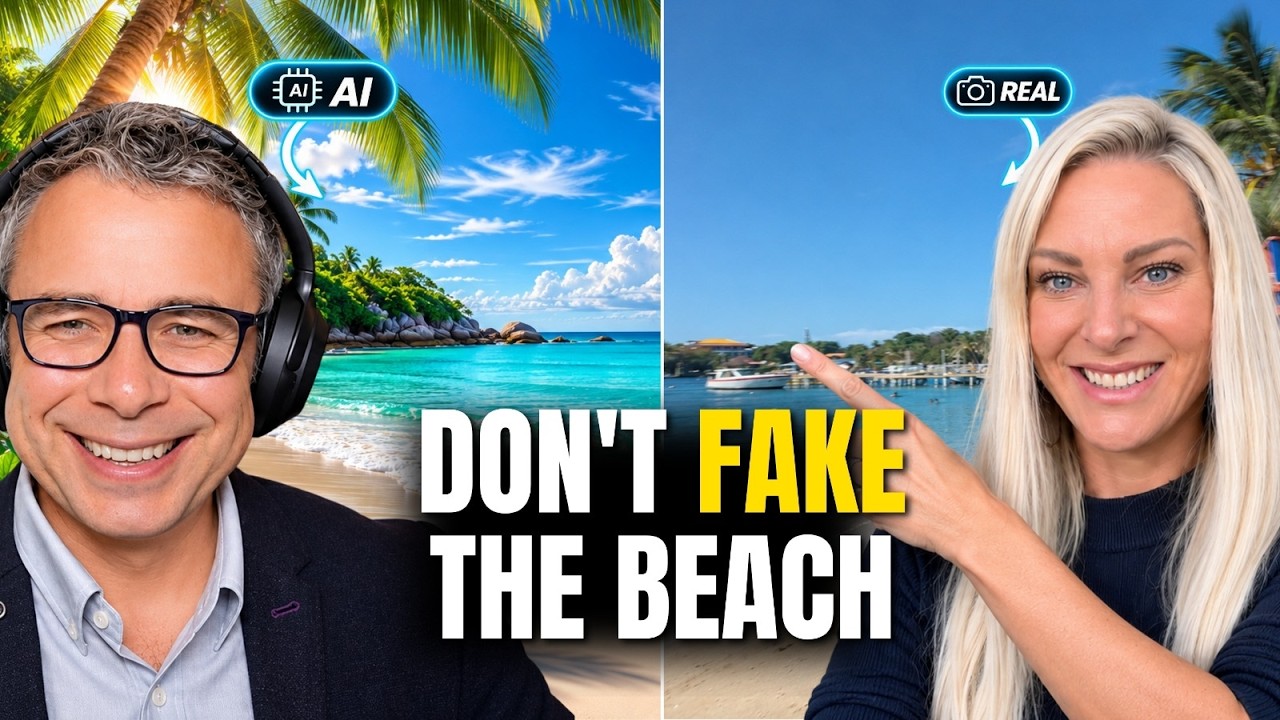
So that tells you — everybody says, "I know we need video." No, you don't need it. You have to have video. If you want your sales to increase 30% by quickly just embedding content, but they struggle — how do I get it? It's too expensive. Well, there are new solutions out there. And AI is not one of them. Because AI — you're soon going to have to, much like you're seeing on social media, "this was made with AI" — people are going to have to claim if it's AI-made. Nobody, as I say, would make an AI fake toothbrush for someone to purchase. Why would you do an AI beach of your location? You're really going to lose trust with travelers quickly. And that's the big question I get asked all the time. "Yeah, but I could just make an AI video." Yeah, the second you get there and your customer realizes they've been duped — destination dupes is what they call them — you lose trust instantly. And that's what I do — not in a world where everything's AI and you don't know what's real. It's becoming that.
Alex Brooker: And that's part of the reason we're doing this kind of podcast — an authentic conversation with the founder to talk about the real things. It's obviously not AI.
Sally Bunnell: No, no. I am real, right here, fully spending time. Hair color might not be real 100%, but everything else is.
Alex Brooker: So, okay, let's take a step back. I'd love to hear your story about how you actually got started, and perhaps what led up to you pitching this idea or discovering this problem that could be solved in the travel and tourism industry. What was happening just before that, and how did you get into it?
Sally Bunnell: Well, I had no intention of being in travel. None. I studied broadcast journalism and marketing at the University of Nebraska in Lincoln and was always very much involved in the entertainment side. I was a radio disc jockey. I was working with ABC Sports, college football, so I was doing live television. And I got an internship at The Late Show with David Letterman, which moved me to New York City, where I worked on music and television combined. And from there I went off to a record label. At that record label, I was pretty much the head of video content for 11 years. So I saw the rise — well, the change — in video over 11 years, from 2005 to 2016. That dates myself a little bit. But we were shooting with big cameras, big Reds, and it was a production — a production company that we were running and executing.
As we advanced, one of our brands — I was directing music videos and producing them and commissioning as well on behalf of the label. So I'm traveling all the time, always working with new video technology. I remember before the iPhone, there was this little kind of video stick that shot kind of like a GoPro before GoPros. So I'd capture moments and I'd be going on trips. Now, this is before Instagram Stories, TikTok, any of these existed.
Alex Brooker: Okay, yeah.
Sally Bunnell: So I'm traveling all over the world, shooting music videos, and I start seeing people say, "How do I go do what you did? I saw you were just running around in this place." And so what I was doing is starting to put together my itinerary for when my trip was, and then I'd just send the little videos. So this kind of started in this direction. That was probably 2011. And then as technology advanced, I was able to get an iPhone that recorded video.
So one of my productions was a brand called Kidz Bop — kids singing today's pop hits, clean versions. I was directing all the Kidz Bop videos.
Alex Brooker: That sounds like a lot of fun.
Sally Bunnell: You know what they say — the three things to never work with are kids, animals, and kids' parents in show business. But I did pretty much all three of those in one commercial at Atlantis Resort. So I don't know what I was thinking.
So what we did — we were launching the first kids' YouTube channel. Here we are taking this content, giving everybody phones, having them shoot it from their point of view. This was the original user-generated content. I shot what was probably over a quarter-million-dollar commercial, and yet we took all the footage and put this kind of content up against it on YouTube. And I was getting better click-through rates on the kids' content than on my quarter-million-dollar commercial that we were putting on television.
Alex Brooker: Wow, okay.
Sally Bunnell: And I thought, holy — I'm going to be out of a job if people can record it themselves. This is the new wave coming. And that really was the differentiation of video content from high production — it wasn't about high production value anymore. It started to make things believable and gave you a personal connection. It was kids watching kids. It wasn't adults saying you should watch this as kids. So that was really where we started to see this jump.
And that's when I put together what is now NaviSavi, as a pitch to a TV show — an interactive, bookable travel show in 2013 that I was pitching to major networks. It was basically: we show you an episode on television, but it was all short-form video that you could plan and book a video itinerary from afterwards, all from short-form user-generated content. We pitched from 2013 to 2016. Every network turned us down. I wasn't Insta-famous enough — this is when the Instagram star was coming out, before Reels or Stories. And every brand was like, "Does the platform exist?" I said, "No, I'll just partner with Expedia or somebody to do the fulfillment." And they'd say, "Oh, okay."
Finally, in 2017, I thought, you know what? Screw this. I guess I have to go build it myself — it doesn't exist. So I did. I set out and decided to learn about tech and startups. I didn't know what a pitch deck was. I can get kids to dance and smile and perform on screen, but when it comes to a pitch deck and knowing the technology behind it — and this is also before AI tools became so relevant — you had to hire true developers, UX designers, and think the whole process through.
So I started this pretty much as a crowdsourced, user-generated content platform for travel. I approved every single video that came on the platform, put all the information in, checked it. It was a labor of love. I had investment in 2019 and we were set to launch April 1st, 2020 in New York City. And guess what happened about three weeks before that?
Alex Brooker: Yeah.
Sally Bunnell: So I took that time in 2020 and reached out to every influencer I could — because everything was Zoom meetings and conferences — and said, "I need you to upload videos. You're not traveling. You're not monetizing them. I'll pay you to upload." So I did. And I started getting creators all over the world to start uploading content to help source our B2C fulfillment. And then we came out with the app officially in 2021, B2C, and really just turned it into a content engine at that point.
We got noticed so much that I got a random notification from LinkedIn from a person at Meta. And I was like, what? What is this about? Who's watching me? Is this real or is this fake? Is it a competitor? So anyway, they reached out and said, "Hey, we see you have a ton of travel videos on this platform. We're launching a new thing called Facebook Reels. Would you be interested in helping us launch the travel portion?" And I thought, absolutely. So I actually provided all the travel content to Facebook Reels when it first launched as a test.
Alex Brooker: Fantastic. So when Meta comes to you and asks for your videos, you know you're doing something right.
Sally Bunnell: And then it became a very tough environment. No matter what, in a B2C environment with travel investment, it was the worst timing — investment has been pretty difficult in the last five years for pretty much everything, let alone travel. And also the fact that female founders only get less than 2% of all venture capital funding. So when the odds are stacked against you and you're still surviving — we luckily got picked up and chosen by Techstars a year later, a tech accelerator. They gave us our first six-figure check and we then pivoted into more of a B2B play and continued to grow since then in 2023 and 2024. And yeah, we're now in 2026 and still here. We have an array of products and a wealth of experience from a startup founder point of view.
And really seeing how video has grown and changed as well — I see a lot of people come in and say, "I wanted a TikTok for travel," and it's like, kids, you have no idea the time and effort it takes behind this, to just come in and say you're going to vibe-code an app.
You have no idea. I was a young woman when I started this company. I feel like I'm no longer. Might as well get my senior citizen benefits soon out of this.
Alex Brooker: And just to check — you're not checking every single video at this stage?
Sally Bunnell: No, not me personally — I have a team that watches every single video. And we have a layer of AI that comes in first, so it has to be shot in the right format. We have to be able to scan the video and get the original metadata, because you'd be surprised what people were doing for a dollar — we were paying a dollar per video approved at the time. So people would screen-record other people's videos and then upload them, recropped. It was insane. So we have to go through a technology layer before it gets to a human eye, and then start adding the booking links that we have through our API and our systems and bring all that metadata with it.
And through the process, we scan it based on emotion. We can even pull out the colors — so if you want a collection of blue videos, we can start pulling that back. It's very interesting.
Sally: And then we have a human eye watch that, because we do then license those videos onto major travel brands. So coming from video, I'm very well versed on — you can't have logos, you can't have music in the background, you can't have this. So we curate a lot of that. We can, if they do want a video, we have capabilities of stripping out the sound or blurring a logo or faces, but we usually don't put those up on our B2B site for licensing. So what we have on our app is a different story because those are crowdsourced content, but we're not reselling them.
So we kind of made an ecosystem where brands have it easy to come in and capture that content, but it's a human eye. And I always get asked, are they AI videos? I say, no, no, they're not AI. They're real travelers, real people, real experiences.
Alex: I was just thinking, could I upload Lord of the Rings and say, oh, look, check out this New Zealand landscape?
Sally: You could, if you were there and did the Lord of the Rings experience, yes. But we also have it so it has to be something which, you know, helps the traveler make a decision. It can't just be a selfie of you and your friends having a good time. It has to tell the — it's not about the creator. And I think that's where we differentiate very much from Instagram. It is: show me the experience. What is it going to look like in first person? We say it's that vision of when you stay at that amazing hotel room and you call somebody and say, look at this — that is what we're capturing. So people can feel what it's like to put themselves in that traveler's shoes.
Alex: Exactly. And a lot of times you can create these 3D mock-up renders, so it gives you an idea of like the room size, but it's not giving you the vibe. It's not giving you the energy of a restaurant and location.
Sally: And so that's what we're really there for — if I was to sit there, how would I see it?
Alex: Yeah, I totally get it. And some of those techniques like re-cropping other people's videos — that sounds pretty crazy. So it must be quite a big job to monitor and police that.
Sally: Oh, yes. Those videos — when we were young and starting out, we had interns helping us. We did a huge content cleanup a year or so ago, and we got a team of about 10 people that went and watched every single video — over 250,000 videos. I felt bad for them, but I, you know, I sat in that position when I started the company. I've done every job, so minus coding myself, I've done pretty much everything at least firsthand.
Alex: Fantastic. Yeah.
You mentioned the male-female balance in terms of securing VC or working with VCs and getting funded. Aviation itself is heavily skewed male. How have you found working with airlines and travel companies and experiencing that male-female balance there? Particularly like World Aviation Festival — you sort of look out and it's obvious.
Sally: Well, when we had the booth, I remember people coming up to my two team members — my CTO and my head of product — and I kind of gave the sales pitch, and they'd say, "Oh, you work in the marketing department or PR?" I said, no, I'm the CEO.
So that's always the fun. But my team is really great about it though. They're like, "Well, if you'd like to talk to the boss, she's right here." There are great supports around it. But I think it's definitely a male-dominated game in aviation. Travel in general, you know — I sit on a lot of these boards of women leading travel, and most of the women there, in all honesty, are the communications experts or the marketing or the PR people. There's not a lot of women there that are CEOs of these companies. They work high up at major brands, but there's not a lot of us going out there trying to access funding.
So in terms of the aviation side, they have been very open to understanding they need video. I think the toughest difficulty with aviation is it is such a long game. They have time to wait you out. They move very slow. And as I said, we touch so many different products across different teams in aviation — from in-flight entertainment to innovation to loyalty to marketing — they just don't know where to start with us. Everybody starts with, "How about I get some videos and put it on social media?" That's a great place to start. It's quick and easy and you can go in and look yourself and download them, use them as needed.
So it's a good, quick way to start, but it's really taken several years — as we've talked to even connectivity providers about how do we, you know, one of my big goals was how do I enable the first buy-on-board experience in terms of watching a video, whether that came through your seatback map, seeing things to do before you land, watching the video and making a purchase. Where does the connectivity live? Where does the map system live? That's something we're looking at — how do we take this content from your home screen to your seatback map? And how are these long-form programs and short-form content able to follow you along your entire journey? Maybe you got inspired while you're flying home from your last destination, watching this content, to go somewhere new.
So that's kind of where we're really trying to get to. I call it NaviSavi Everywhere Travelers Watch. That is what I'm really trying to hold to — it doesn't just have to be in marketing, it doesn't have to be from your home, from your social feed. It's every part of the journey.
And I think when airlines understand that 360 value, especially when it comes to loyalty — getting rich, first-person data that's shared directly in exchange for loyalty points — it benefits both sides of the coin. So I think it's really about looking at it as a whole instead of just, you know, independently: videos for marketing, we'll deal with you later.
Alex: Yeah. So which kind of videos perform the best? For those travelers out there who may get the opportunity to do this — is it a photo, is it a video of the guy with the boat in the corner who doesn't have a website? What sort of — perhaps give the listeners and viewers some idea — what's the best performing user-generated content in your experience?
Sally: Well, it's best if it has a subject. Your eye is always drawn to a subject or a point of interest. So it might be you're on the beach, but is there a surfer you can see in the distance? Sometimes we even have our travelers do silly things — they might have their toes hanging over this enormous cliff. What's your quick attention grabber? Because in today's world, what used to be seven to eight seconds of attention span has cut down to almost one to two to three, depending on the platform.
Alex: That's insane.
Sally: But our content, as we're watching through our platforms, we're getting on average about 12 seconds per view of each piece of content. Most of our content maxes out at 30 seconds, but most of the content probably sits around 10 to 15 seconds on average.
So it's understanding what is grasping attention and finding something interesting — you know, I get a lot of content that's just this. But coming from a director standpoint, what happens when you walk through the cave like this? It's the first-person point of view coming at you, because that's what travelers are really resonating with. How do I see and view this as if I was there?
And yes, I always say 60 frame rate, just to give it a little bit of that edge. You don't have to have full stabilizers or anything anymore. Phones shoot some of the best content — this is better quality than what I used to shoot 15 years ago. It's right in the back of your pocket. So it's a total game changer in how people are sharing experiences quickly, efficiently, and instantaneously.
Alex: Yeah. And then how can people find out more about you, about the company, and events coming up where they can perhaps meet you in person?
Sally: See me in person? Well, I'm pretty much omnipresent — I'm everywhere all the time. I'm a full-time digital nomad. So if there's a conference happening, it's probably likely I'll be there, because we touch everything from multi-day tours to airlines. WTM I'll be at, Phocuswright, Arival conferences, WiTS — you name it. I'm everywhere, from the creator standpoint to the brand standpoint. As I say, travelers watch.
In terms of getting in touch, I'm on LinkedIn and I'm very vocal there — I try to have an opinion, a personality, and a voice about whether it's just our company, video in general, or fundraising. I don't shy away from things. As when I met you, you're like, yes — I've been called a lot of things in life, and shy and boring have never been either of them.
Our company is called NaviSavi, and most people say, "Well, what does NaviSavi stand for?" I say, navigational savviness — savvy travelers, savvy brands, savvy creators start here. And we're spelled N-A-V-I-S-A-V-I, so it's a little play on words. We're NaviSavi Travel, and you can find us in different formats at NaviSaviTravel.com. We've got a site that serves three different audiences — the travelers, the influencers, and the brands.
There is a Savvy Navi out there, but it's boat navigation, so we're safe on that. We did find out about them and we have talked before — "Oh, that's cute." So we'll keep out of each other's chartered territories.
Alex: Very good. I remember when I first met you at World Aviation Festival, it was like, "Hi, I'm Alex. Would you like to come on my podcast?"
Sally: And I did not say no. I said, absolutely — when do you want me?
Alex: Exactly. Listen, Sally, it's been absolutely fantastic to talk to you, to get to know you a bit better, learn about your company, and hear your story and the background. I wish you every success in the future. Thank you so much for coming on.
Sally: Thank you so much for having me. And thanks for letting me speak to your audience — video can touch a bit of everywhere. It's really about understanding that video is what's connecting us to the future and purpose and purchases. It's really going to have a deep meaning in all of our lives. If it hasn't touched you already, it will very soon.
Alex: That's a fantastic note to end on. Thanks, Sally. That's brilliant.
Sally: Thank you.
Related episodes
Every episode, in your inbox
One email per Travel Tech Podcast episode: the conversation, the key takeaways and the use cases worth building in aviation and travel AI.
Give your agent aviation tools
General assistants guess at aviation codes and get them wrong. Agent Tools give Claude, ChatGPT or your own agent checked answers instead. Free plan, no card.
Connect your agentAbout the Travel Tech Podcast
Hosted by Alex Brooker, founder of Airside Labs, the Travel Tech Podcast features authentic long-form conversations with leaders, innovators, and startup founders shaping the future of aviation and travel technology. No scripts, no sponsors, no sales pitches — just real conversations about building technology that matters.
Have a story from travel or aviation tech? Come on as a guest.