
Every episode, in your inbox
One email per Travel Tech Podcast episode: the conversation, the key takeaways and the use cases worth building in aviation and travel AI.
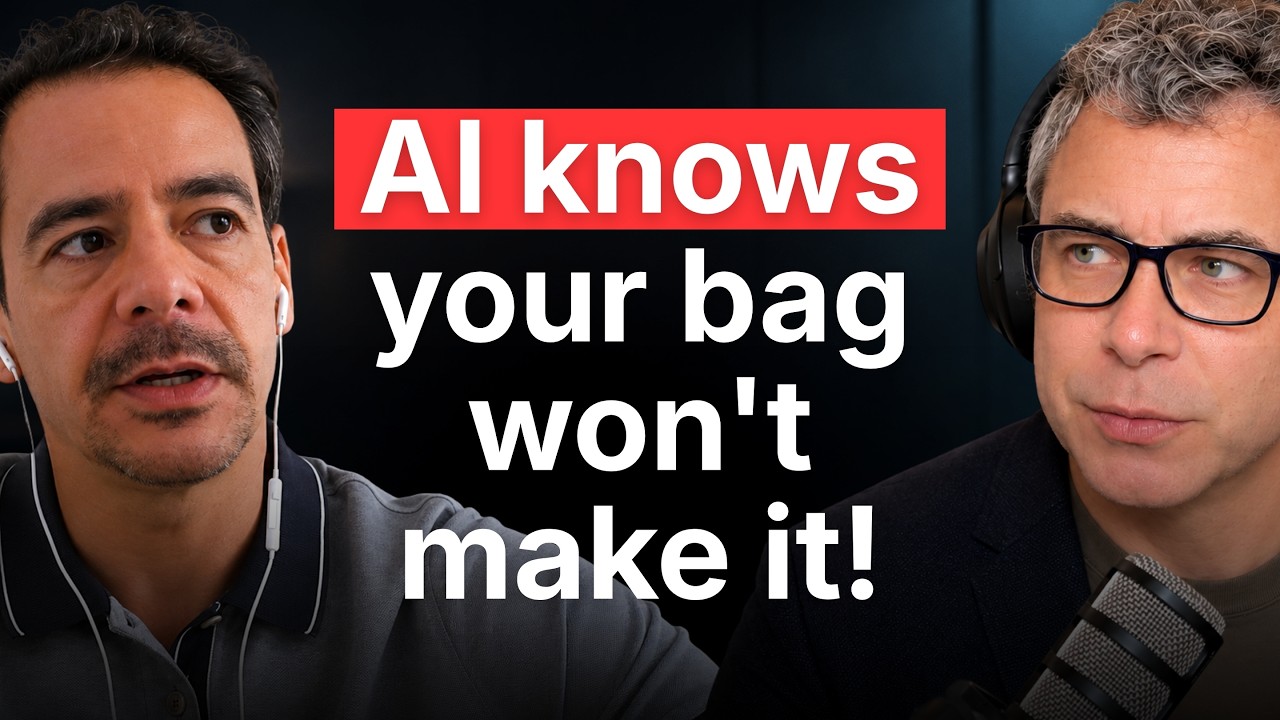
AI Knows Your Bag Won't Make It: Predicting Connections Before Takeoff
Before a passenger in South America has even boarded an eight hour flight to Lisbon, an AI system is already calculating whether their bag will make the connection. Ismael Pacheco, co-founder of Out of Limits, explains how his Lisbon aviation software company turns baggage data into knowledge operators can act on, from smart warnings in the baggage control room to computer vision turnaround systems now live at Portugal's three main airports.
Show Notes
Ismael Pacheco is co-founder of Out of Limits, a Portuguese aviation software company founded in 2006 whose roots go back to a 2002 university simulation project at Lisbon Airport. The company began as a baggage consultancy before Ismael and co-founder Ricardo turned it into a product company, building its software inside live airport environments alongside airline and airport partners. In the conversation, Ismael explains how baggage handling suppliers have historically kept data inside proprietary black boxes, a problem he met again on a South American project this year, and how passengers who expect a notification that their bag is loaded are now pushing the industry to open that data up. He walks through Out of Limits' transfer prediction, which starts assessing whether a bag will make its connection at check in, before an eight hour inbound flight, and keeps updating as taxi times and baggage hall lead times change, so a bag on a tight connection can be moved tail to tail. He also covers how to set the severity of control room warnings to match the disruption a fault can cause, and why five minutes of baggage terminal downtime can take an hour or more to recover. The episode closes on NeuroStand, the company's computer vision turnaround system live at Lisbon, Porto and Faro and being deployed at Budapest and Lyon, and Captain, an AI agent that monitors assigned flights and raises warnings while human operators make every decision.
Read the takeaways
AI That Knows Your Bag Won't Make It
The best test of an airport system, my latest guest argues, is whether the phone rings within a minute of it going down.
Read the newsletter issueFull TranscriptClick to expand (5,525 words approx.)
Ismael Pacheco: Aviation is a big, big shark industry. You have big players and then you have very small fishes that are trying to do things, but it's not an easy job to penetrate and to have things running. It's something that you need to go with a lot of resilience. I think people are much more open to startups, to small companies that came with smart ideas that can help in a very quick way to improve something.
Alex Brooker: Hi, everyone. Welcome to this week's episode of the Travel Tech Podcast. This week, I meet the founder of a company that really fascinated me at the World Aviation Festival recently in Lisbon. This is a Portuguese homegrown success story straight out of university, solving problems for an airport in Lisbon and building up from there. It's a really interesting conversation with Ismael Pacheco from Out of Limits. I really hope you enjoy this content. Please keep the feedback coming. I love hearing the comments and receiving messages. Reach out to me on LinkedIn. Let's see if you could pitch, get yourself on the Travel Tech Podcast in the future.
This is brought to you by Airside Labs. That's airsidelabs.com. Please don't forget to like and subscribe. It really helps me out. Thank you for your support across the channel. Let's get into it.
So, Ismael Pacheco, it's great to have you and welcome to the Travel Tech Podcast.
Ismael Pacheco: Thank you. It's a pleasure to be here and I'm looking forward to having this lovely discussion with you.
Alex Brooker: Yeah, no, it's great. We met at the World Aviation Festival very recently and you were exhibiting there. I'd love to know a little bit more about — before we get onto the business side and some of the deep aviation challenges — I ask all of our guests on the pod: how did you get into aviation? How did you get started?
Ismael Pacheco: Oh, it's a funny story. It was back in 2002, so quite a long time ago. I was doing my university studies, me and my partner, co-founders of Out of Limits. At that time we were in a school category called simulation, so we had to make a simulation work to pass the class, and my partner at that time came to me and said, "Well, what if we talk with the airport and try to do something around the baggage terminal?"
And that's it. We sent some emails, there was some back and forth to talk with the right person, but fortunately we had the chance to talk with the right people and we started to do university work for the class. It was very good — we got 20 on the studies, so it was a very high grade. And since then, we did our internship also in the aviation area, and then we started working and we founded our company in 2006. So I would say that since the beginning of my work experience, I've been in the aviation industry.
Alex Brooker: So from the very beginning. I love it. Is the challenge that you are taking on today with the business the same thing you were researching and investigating just a couple of years ago when you were coming out of university?
Ismael Pacheco: Well, I could say that in some airports and in some cases, I really believe that the challenge is still the same and it's still there.
When we came to Lisbon airport and we started to talk with people and to understand where we could do the study and so on, what we found was a big, big black box around the baggage handling systems. All the big stakeholders — Siemens, Vanderlande, Beumer — were keeping all the data inside their own black box and didn't want to share much information. And if you needed to find some information, you had to dig into T60 files and it was a nightmare.
So I find that in some cases we still have this type of challenge. I can share that we finished a project around baggage in South America this year where we still found some resistance from the baggage handling supplier to access the data. And when they don't show resistance, they put a very high price to the airport to give access to data that is from the airport's side. So the challenge is still there.
Nevertheless, it's also fair to say that even the big players now are more motivated to look at data and more motivated to listen to what customers want, because as you know, nowadays everyone is looking for data and trying to do the best they can transforming data into knowledge — which is one of our key phrases. So there are more open doors, but the challenge is still there, as it was in the beginning.
Alex Brooker: So what do you think has changed to unlock some of those conversations around data access? Is it from the customer side, the airport side? Is there more collaboration, more openness, do you think?
Ismael Pacheco: I think it's a mix. Even on the end user side, on the passenger side — you as a passenger, you are demanding more information about your baggage when you travel. The airlines are starting to give you notifications about whether your baggage is or isn't loaded. If it's not loaded, it will be on your next flight. So they are demanding more from the suppliers even at the end user level.
It starts with the airport people, who are the owners of the infrastructure and want to understand better what is happening. And in order to understand, you need data. As Peter Drucker mentioned a long time ago, you cannot manage what you cannot measure. So it's always around data. And the passengers, the end users, are demanding more. I believe this is the reason why they are more open now.
Alex Brooker: Yeah, it's interesting. I love it — you're referencing one of the OGs, the original managerial gangsters, Peter Drucker. I love it. So let's talk about the business. Out of Limits — I'd love to learn a bit about the problem you solve and how you go about it.
Ismael Pacheco: I'll speak a little bit about the history of OOL so you can understand how we managed the challenges over the years and where we are now. In the beginning, the company was much more a consultancy company working in the areas we had learned inside the baggage world. So we were making studies, proposals for improving current BHS layouts, some modifications on the software from the providers, and so on.
At that time, me and my partner Ricardo had a conversation: "Well, once we have the knowledge and we are a consultancy company in that area and we've found the gap, why not change the direction of Out of Limits to a product-oriented company?" And we did that. We stopped almost all the consultancy work and pivoted to a product-oriented company, and we started to develop our baggage suite.
And I'm happy to say that it was at the right moment. We took advantage of our knowledge, and together with our customers this solution was built with airports and with airlines inside the real environment. We don't develop things at home and then go to the ground and see if they work — we develop inside the real environment, which helped us a lot. And that was the idea: to go in that direction, to see where we can bring added value, where we can improve the efficiency. And that's it.
Alex Brooker: So if you were starting again today — because when I was at World Aviation Festival in the startup village with lots of other tiny startups — would you recommend that consultancy-first-before-going-to-product path? If you were to start again tomorrow, would you do it that way around again, or would you jump straight into product?
Ismael Pacheco: It's a tough question. I really believe that you have to feel the moment. When we were a consultancy company, we were not in a position where, if we started to develop software, we would have had success.
But no two cases are equal. I think nowadays people are much more open to startups, to small companies that come with smart ideas and agile structures that can help in a very quick way to improve something. But 20 years ago it was not like that.
In this industry — and I used to say this — aviation is a big, big shark industry. You have big players and then you have very small fishes that are trying to do things, but it's not an easy job to penetrate and to have things running. It's something that you need to pursue with a lot of resilience.
Alex Brooker: I agree. Yeah, I'd love to talk a bit more about that resilience side. But before we do, I'd love to get back to the problems that your company solves in the industry. I understand you've been pretty successful recently. I'd love to learn a bit more about what you're working on and those challenges and problems that you solve in and around not just baggage, but all of the use cases that you cover.
Ismael Pacheco: Okay. Starting on the baggage side — what we like to say is we transform baggage data into knowledge. We don't solve problems by ourselves. What we do is help, together with our software solutions, to bring added value to companies in order to save bags.
Imagine the use case here at TAP with the hub in Lisbon. When you are in South America doing your check-in, what we are looking at at that moment — even before an eight-hour flight — is whether, when you arrive, your bag will make the connection on the next flight based on all the conditions. And we are constantly updating this information when the aircraft is in the air, when the aircraft is landing, monitoring the terminal conditions, whether the lead times inside the baggage terminal are higher or not, whether the taxi times are bigger than they should be. And we are providing accurate, real-time information so that people can make the best decision in time.
So imagine you have a very short connection — what we will do is recommend a tail-to-tail transfer. If you do a tail-to-tail, the bag will make the connection. If it goes to the main terminal, it will miss the connection. So these are actions that our solution can provide to airlines and to airports in order to avoid mishandling and to improve efficiency.
In terms of an airport view, on the baggage handling system control rooms, we design specific dashboards that focus on what's important — checking certain occupancy rates. If the occupancy rate starts to rise above a certain percentage, we have smart warnings that alert the people in the control room. I don't know if you're familiar, but in a control room at a complex airport you have a lot of signals — you have the SCADA, you have the CCTV — and sometimes you have a lot of distractions. What you need is smart warnings that alert you to what is really important, and most importantly, give you precise indications of what you should do in order to avoid a disruption. Because when you have a disruption, sometimes a disruption of five minutes inside the baggage terminal will take you one hour or one hour and a half to recover. And this will delay flights because the baggage will not arrive in time at the chute, and this is a rolling effect in the process.
That's how we look at bringing value to the airport. On another front, something we have been working on for the last three to four years that we also believe will be a big step for Out of Limits is our NeuroStand solution for smart turnaround — turnaround with the help of AI and computer vision. We look at the existing CCTV or newly installed CCTV on the stands, and we are trying to create a common framework where all the stakeholders involved in the process can share the same information and ultimately improve the turnaround process. That's what we are working on.
Alex Brooker: So just back to the first use case — you talked about what it's like inside a complex airport control room, with an operations team being bombarded with lots and lots of different information. How do you decide, how do you define, what's important when there's so much information being shown to the humans in that room?
Ismael Pacheco: That's where the knowledge comes in, and that's why we normally say that we build this together with airports and with airlines and not back at home. Because we were in the baggage area all day seeing what is important. Imagine a scanner with a low read rate — normally you have 30 scanners, so it's not an issue. But if it's a scanner on an induction line of a sorter, and the read rate starts to go down — it could be just a photocell alignment that's not correct — if you start to see on the last 100 bags that passed that you have a drop in your percentage and you immediately alert the people, they can proactively go there and avoid the sorter starting to back up with a lot of bags inside.
Why? Because if you have an induction line with a problem in the sorter, the bags will remain in the sorter until they go to the manual encoding station. That is a process that takes more time. And if you start to have a lot of bags inside the sorter going to the manual encoding station, this will congest the sorter and it will start to back up. So that's an example. You have to know that a poor read rate on a scanner after the check-in area is important, but it's not so critical on an operational basis — you can raise the warning, but there is some time to take care of it. If it's an induction line, you must take care of it now, otherwise you will have issues.
Another example: a full chute. If you have a full chute, normally people say, "Well, you have a lot of full chute time." Yeah, it could be because the handlers didn't remove bags, and so on. It could be a problem for the sortation. But you should look at it and ask: how many bags do I have en route to that chute? If I don't have any bags en route to that chute, it's a warning, yes — you should pay attention — but it will not cause a disruption. But if you have a lot of bags en route to that chute, then you should pay attention. Then the warning is more critical. So the severity of the warnings has to be aligned with the severity of the problem they will cause.
And this you cannot learn if you are not together with the people on site and don't understand the various reasons behind it.
Alex Brooker: So what's the balance of that information — the knowledge that's in the brains of the people working there versus the data in the system? Because I totally agree that to get that understanding you describe, you have to be there with the team to experience it. I'm really interested in your view of that. How much of it is in the people and how much of it is in the system?
Ismael Pacheco: I would say that in terms of percentage, the people who have worked in that area for quite some time have a lot of experience, so they carry a lot of knowledge in their heads. And sometimes when you try to adapt the systems to —
Ismael Pacheco: Facilitate things — they are a little bit redundant to try to use it because it's on their head and they don't believe in recommendations of systems and so on. So if I have to say, I would say that nowadays the systems have the capability to have more knowledge than the people, but this is because they were trained for it.
Nevertheless, you should not set apart the knowledge of a good operator in the baggage handling room, because if the system is down, you have the perfect knowledge to solve the problem. And if you trust only on the software, it could be a challenge.
I don't know if it's 20/80 or 50/50. I cannot put a percentage on that.
Alex Brooker: Yeah, sure. But it makes sense that those experienced people are still vital to be there and in control, even if the system has a little more data and a little more information about the situation. You still have to have those humans with that experience actually operating it.
All right, look, let me pick up on that point and tell you a little bit about what we are doing with AI now that everyone is talking about AI and so on.
Ismael Pacheco: So in the WAF, we launched our AI agent that we call Captain. And what we intend to have now is Captain monitoring flights on the turnaround management. So imagine this — you enter on the shift, you ask Captain, "Captain, I'm entering on the shift now. Where should I look? What should I take care of?" And Captain will give you a summary and highlight what you should do. And then you can say to Captain, "Okay, so based on this information, please monitor flights A, B, and C." And your AI agent will work behind the scenes and you will concentrate on doing other things, and your AI agent will warn you about specific things that it was trained to.
But at this moment, it will not take any action. So it will warn you, but the human will take the actions. And I believe that this is the best way, at least in the next — I would say years, but with AI, you never know. You sleep and you wake up with different technologies, so the speed can be much more vertical. But I would say this should be the way: the human always verifying and taking the last decision, because you are involved in an operation that can have a huge impact.
Alex Brooker: And so talking about AI, because everyone is talking about AI — what's your opinion on the use of AI inside a company like yours? Has it transformed how you run your company? Or has it had less impact? What's your opinion on the use of AI specifically internally first?
Ismael Pacheco: Straight on, it improves a lot the... sorry, let me think of the word in English.
It reduces a lot the time for delivery. It's not the perfect sentence, but it has a huge impact. Something that would take me one week to do, I can probably do now in two hours. So we are a software company, and if you are a software company, a small company, an agile company, time is money. And if you reduce the time to market while keeping the quality, it's a huge change, because it gives you the opportunity to improve your efficiency, to improve your time to market. Internally, AI is something that we use as a daily basis tool.
Alex Brooker: Yeah, no, that's fantastic to hear. And then on the product side, how ready do you think the operators in those kinds of roles in the airport — like the people perhaps in the control centre that you've spent so much time with, or the baggage control room that you've spent so much time with — how do you think they feel about the use of AI in the tools that they are working with?
Ismael Pacheco: I would say that they have mixed feelings. They are sometimes a little bit alarmed because they are afraid of being replaced by AI agents. But on the other hand, I'm starting to get feedback that they believe this is the best support they can have, and they're starting to feel more confident and more open to working with this type of tool. But it's always a paradigm shift, and they, as we — all of us working people — we have some fears, and this is something I feel on their side.
Alex Brooker: Yeah, that's really interesting. Just that human side of things, because it's sort of everywhere and accelerating all the time.
Well, let's go back to what you were talking about earlier — the latest innovations you've been working on around the turnaround and the use of AI to understand events from CCTV. I'd love to learn a little bit more about that. Could you explain the challenges? Why is it important to improve the turnaround? Maybe back to basics — could you explain why that is a challenge and why it's interesting for an airport to work on?
Ismael Pacheco: From an airport perspective, I would say that the main goal is to improve the efficiency of stand occupation. And by improving the efficiency of stand occupation, you will also improve the runway utilisation, and at the end of the day, you will improve the number of passengers passing through your airport.
Taking the case of Lisbon, a very, very congested airport — every second counts. So if you know better, if you can predict what will be the actual time of exit from the stand — the TOBT, the Target Off-Block Time — if you can accurately predict that timestamp, you will be able to better manage all the sequencing on the stands and on the runway.
So imagine this — and it happens a lot — if an operator sends a ready message and says, "I'm ready at 16:15, I'm ready to get out of the stand," but when you check at 16:15 the stairs are still there and the door is still not closed, they are not ready. And they will occupy a slot that could belong to other aircraft in the sequence. And this is why it's so important to have a system that can help you make predictions and decisions based on real-time information.
In order to do that, you need to collect data. You need to timestamp all the events in the turnaround process, and then you need AI to help you predict. AI — everyone knows — the big, big companies are hiring a lot of mathematicians, philosophers, very old and clever people. And AI doesn't work on different things than what we learned in college and high school. It simply uses the same principles with lots of big data and processing power, with much, much faster results. So when you have the chance to have this type of technology working with the data, the results are tremendous, and you can predict with a very high percentage of accuracy what will happen.
And sometimes little things can be big things. If you start to improve two or three minutes per turnaround, and you think two or three minutes is nothing — but when you do that across more than 800 turnarounds a day, it will be a huge, huge improvement over two or three months. So if AI helps you to fill in the little gaps, it will help you a lot on the overall improvement.
On the other hand, you can monitor your process and see where you are missing. Sometimes you need a second pair of eyes to give you a better understanding of where you are falling short and to pinpoint the failures. And it's not necessarily to apply a penalty to your ground handler — it could be — but the main reason is to work together with your partner to understand where you can do better in order to get better results. That's the way we see it.
Alex Brooker: I've wanted to ask you this question. There's a saying that if you've visited one airport, maybe you've seen them all. But I'm not sure that's true. So what I want to ask you is — is every single airport different in terms of the systems, the customer, the situation? Or are they all the same and have very similar challenges? Are they all the same, or is every airport one of a kind?
Ismael Pacheco: I would say it's your last sentence. I have a friend who once said to me, "When you visit an airport, you visit an airport." They are unique. You don't find two equal airports. They are unique because each airport has its own issues and its own challenges. Of course you find some similarities, but they are in different environments. You have to look at them from a different perspective. They are not equal, and you cannot — it's not plug and play. You cannot put everything on a flash drive, go there, and plug and play. It won't work. You can reuse some things, of course, but it's not plug and play.
Alex Brooker: That's interesting. And do you think AI is going to help with that and make things quicker?
Ismael Pacheco: For sure it will make things quicker, but you still need to make some adjustments. I can share an example. We have our turnaround system implemented in our three major airports here in Portugal — Lisbon, Oporto and Faro — and we are now deploying in Budapest and Lyon. If you ask me, did we take advantage of what we learned in Portugal for the others? Of course. But we still need to do specific training there. They have different equipment, different scenarios. The layout of the stands is different, the weather is different, the light is different. So you need to make all the adaptations. Nevertheless, you have tools that, as I mentioned before, can speed up and accelerate the efforts to get there. That's for sure.
Alex Brooker: No, I think that's very clear. Thank you. And so what's coming up? What's next for the business in terms of roadmap? Is there anything you can share about what you're currently working on?
Ismael Pacheco: We have some new things that we will launch in 2027, beginning of 2027, at the AI level. It's top secret, let's say — I cannot share that. We will probably launch a new functionality for the Expo in March next year in Amsterdam. But in general, it's all around improving efficiency with AI behind it. The idea is to go step by step, helping the processes and improving them with AI agents working behind the scenes.
Alex Brooker: That sounds very exciting. I look forward to learning more about that. Is that the Passenger Terminal Expo? Sorry, I said London, but it's not in London — it will be in Amsterdam next year in March.
Ismael Pacheco: Amsterdam, yes — March, Amsterdam, yes.
Alex Brooker: Fantastic. I look forward to learning more and seeing you perhaps at that event. I think that would be a lot of fun.
Ismael Pacheco: We will be there with a booth. You are invited to come to our booth and pay us a visit.
Alex Brooker: Oh, yeah, it would be a pleasure. I would love to. That sounds fantastic. Now, Ismael, how can people find you and find the company and read about what you're up to? What's the website?
Ismael Pacheco: Of course. We have our website, and you can also search for our LinkedIn pages. We are very active on LinkedIn. If you look for Out of Limits or NeuroStand on LinkedIn, you will find us for sure. And on the website, OOL.pt and NeuroStand.pt — you will find us there, and it will be a pleasure to share information with all the visitors.
Alex Brooker: That's very cool. Now, Ismael, the last question, I promise — what should I have asked you that I have neglected to ask you so far? What did I miss?
Ismael Pacheco: Well, I will say that a good question that is not always easy to ask is: if you shut down your systems where they are working, what will be the impact for the airports and the airlines?
A big impact, right? I would say — and I will give my answer to that — it will be a big impact. And this is quite important to me, because if you have a system that suddenly shuts down and the impact is not huge, then your system is not bringing value and it's not changing the organisation.
But if your system, for some reason — and this is my personal opinion — everything that works will at some point stop. You will have a bug, you will have an issue, somehow, at some point in time. What you have to do is be prepared to reduce that downtime to a very, very low level. But even during that low, low, low availability, if your phone rings — that's the answer you want to hear from the customer, because it means the system is really important to them. They are really getting the best of your solution, because if you are not present for one minute, they miss the information, they miss the solution. And that proves that your system is helping them.
Alex Brooker: That it's vital — a painkiller, not a vitamin. A painkiller, essential to help deal with a problem. A vitamin — well, if you didn't take it, maybe you'd notice, maybe you wouldn't.
Ismael Pacheco: Exactly, exactly.
Alex Brooker: Fantastic. Listen, Ismael, this has been so interesting — learning about the systems you're building, the history of the company, and the fantastic work you're doing based in Lisbon. I wish you every success in the aviation business, and I look forward to seeing you again in Amsterdam in the spring of 2027.
Ismael Pacheco: Thank you very much. It was a pleasure to speak to you. Thank you, and see you.
Alex Brooker: Thank you very much. Fantastic.
Related episodes
Episode 25
Fly First, Regulate Later: Why Europe's Rules Are Pushing Drones Abroad
Julie Garland, Sarah Owen
Episode 30
Why Can't I Just Book My Own Trip? Dual Identity, Dreadful Booking Tools and the Real Job of Corporate Travel
Caitlin Gomez
Episode 39
Can ChatGPT Find Your Hotel? Answer Engines, a Fleet of 17 Agents and One Rule Against AI Slop
Jascha Kaykas-Wolff
Every episode, in your inbox
One email per Travel Tech Podcast episode: the conversation, the key takeaways and the use cases worth building in aviation and travel AI.
Give your agent aviation tools
General assistants guess at aviation codes and get them wrong. Agent Tools give Claude, ChatGPT or your own agent checked answers instead. Free plan, no card.
Connect your agentAbout the Travel Tech Podcast
Hosted by Alex Brooker, founder of Airside Labs, the Travel Tech Podcast features authentic long-form conversations with leaders, innovators, and startup founders shaping the future of aviation and travel technology. No scripts, no sponsors, no sales pitches — just real conversations about building technology that matters.
Have a story from travel or aviation tech? Come on as a guest.