
Every episode, in your inbox
One email per Travel Tech Podcast episode: the conversation, the key takeaways and the use cases worth building in aviation and travel AI.
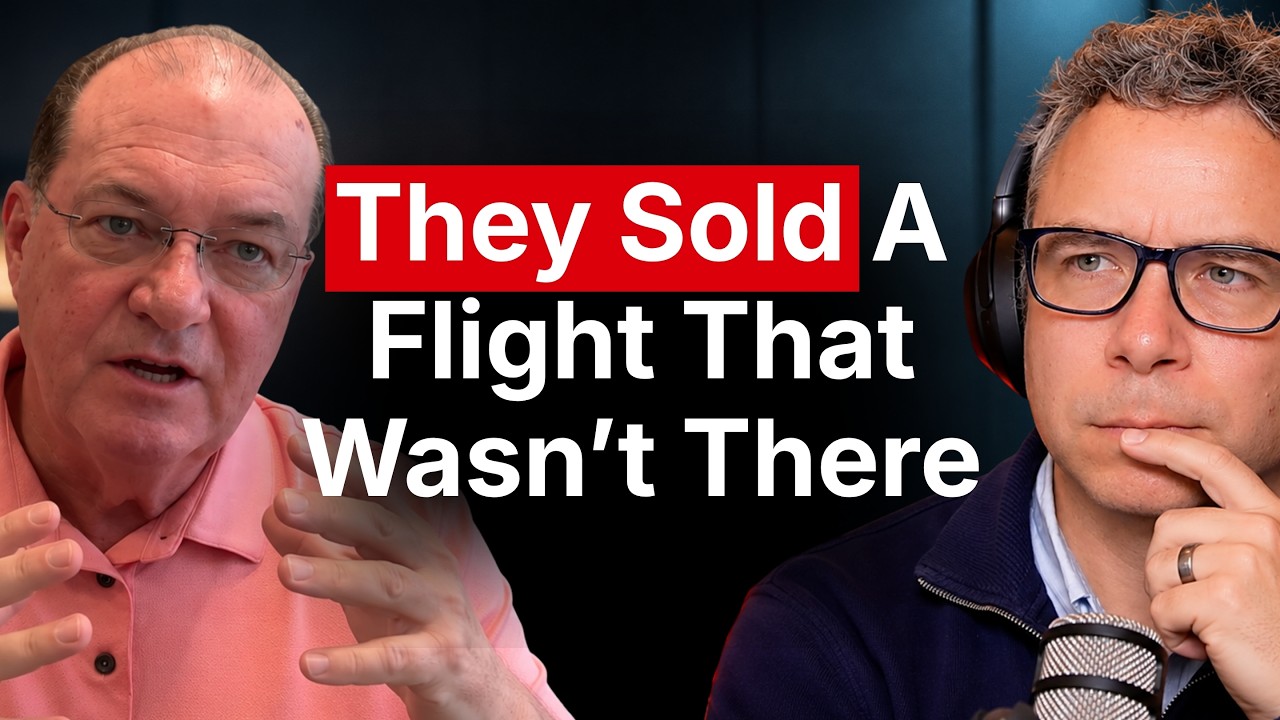
Selling a Ghost Flight: The Costly Mistakes Hidden in Airline Schedules
Airlines have more data than ever, yet the people building their schedules are still holding it together with spreadsheets and Post-it notes. Steve Casley, CEO of Maestrow and former CEO of OAG, has visited more than 20 airlines and found the same desk at each one. He explains why early airline AI budgets went to customer facing products and left the planning teams on legacy systems, and how an agentic AI platform with human in the loop checkpoints is designed to earn the trust of experienced schedulers.
Show Notes
Steve Casley is CEO of Maestrow, an agentic AI platform for airline network planning and scheduling. He was previously a Managing Director at Continental Airlines, where he ran a hub, a partner in Towers Perrin's transportation practice, founder of Back Aviation Solutions and CEO of OAG during a turnaround that pulled the company back from near insolvency, and he has taken three more startups through to exit, one a trading platform for aviation and two in data analytics. In this conversation Steve explains why airlines already have plenty of schedule, demand and booking data but lack the tools to turn it into decisions, leaving network planners on legacy systems that are 25 to 30 years old. He describes why earlier machine learning optimisers stalled: fixed mathematical models would run for three or four days and then fail, because a low cost carrier flying point to point and a network carrier need different logic. Maestrow's answer, as he describes it, is more than 15 specialised agents covering things like crew duty times and maintenance schedules, with every recommendation open to challenge: planners can ask why it was made, reject it, and have the system write its own SQL to redo that part of the optimisation. Steve also describes two expensive failure modes: a carrier that lost about 600,000 to 700,000 a month for three months after one retimed flight broke a connection further along that aircraft's day, and alliance ghost flights, where marketing and operating carrier schedules fall out of sync and partners end up selling flights at the wrong time or on days they no longer operate.
Read the takeaways
Selling a Ghost Flight: The Costly Mistakes Hidden in Airline Schedules
One very experienced planner changed one flight time and broke a single downline connection to a major tourist spot.
Read the newsletter issueFull TranscriptClick to expand (7,889 words approx.)
Steve Casley: When the system makes a recommendation, you can challenge it and say, why did you make that recommendation? It will come back and give you the facts as to why it made that decision. You may agree with it or just not agree with it. And you may say, okay, I see why you did that, but I don't want you to do it. I want you to do it this way. It'll go back, write its own SQL code and redo that portion of the optimization for you. Again, this capability has only been around the past 18 months. Prior to that, this technology didn't exist.
Alex Brooker: Hi, everyone. Alex Brooker here. Welcome to this week's episode of the Travel Tech Podcast. Now, this week's guest has built three startups through to exit, has run an airline, has turned around a global aviation and analytics company, and is now starting over again. It's another guest who I met at the World Aviation Festival Startup Village event, and I think you're really going to enjoy this one.
Thanks so much for your feedback and your comments. Please don't forget to like and subscribe, because it really helps me out with the channel. This is brought to you by Airside Labs — that's airsidelabs.com. Let's get into it.
So, Steve, welcome to the Travel Tech Podcast, sir.
Steve Casley: Thank you, sir. It's a pleasure to be with you, Alex.
Alex Brooker: It's great to meet you face to face. And congratulations on the launch at the World Aviation Festival just last month.
Steve Casley: Thank you. Yeah, it was very exciting, not only to be able to launch the company after being in stealth for several months, but we were extremely pleased with the reception that we got there. One of the great things about that particular event is the Startup Village. Many events have them, but the festival has really put a lot of focus on that, and I think people have learned that if you want to see some of the newest, best, brightest concepts or ideas, that's the place to go. So it was a very successful event for us. We were very happy.
Alex Brooker: I mean, I guess this isn't your first entry into aviation.
Steve Casley: No, no. So a little bit of background. I started in the aviation industry, and the last position I held was Managing Director of Continental Airlines, running their Newark hub — now United. And from there, I became a partner in Towers Perrin's Transportation Practice. I did about 100 various assignments for airlines and aviation-related companies around the world, and then started my first startup, which was Back Aviation Solutions. There are still people around today that remember it, and parts of that still live on in other companies who have purchased various databases that we aggregated and tools that we built.
From there, I sold that company to Commonwealth Business Media, which was then purchased by United Business Media in the UK, and they formed the UBM Aviation Group. They kind of had a war chest for acquisitions, so I went out and looked for other bolt-on acquisitions, and one of those was OAG. I served as the CEO of OAG for three years during its turnaround, because at the time, unfortunately, it was very close to insolvency, and it really sent a shockwave through the industry because it was the only aggregator. Cirium didn't have a schedule database at that point. So people were like, oh my goodness, if OAG goes out of business, what do we do? But we were able to turn it around, and it was great. And I also had three other startups — zero to exit startups — one focused on a trading platform for aviation, and again, the other two were in data analytics.
Alex Brooker: Yeah, I mean, it's a fascinating history. But I'd love to hear your perspective. You've been on the operational side, you've run an airline, you've created multiple data companies in aviation, selling products to airlines and worked with them directly from a consulting perspective. So what do startup founders who enter the travel tech market get wrong about dealing with airlines?
Steve Casley: I think a couple of mistakes they make is thinking, wow, we've built a really great shiny object and everybody's going to want it.
We kind of took the reverse approach. We said, what is the biggest problem that airlines are currently experiencing and that we can solve? And then let's go out and solve that problem. So I think product-market fit is really key. If you design your product to solve the problem, rather than designing a product and then trying to convince people to use it, it's a much more successful approach. And we spent a lot of time on this.
It wasn't just the advent of AI and a kind of technology revolution that pushed us into this. We had been researching the problem for quite some time. I have visited over 20 airlines — some with a fleet as small as 10 airframes, some as large as a thousand. And I see the same problem over and over again in North America, in Europe, and in Asia. I go in and there's a network planner or scheduler sitting at their desk, like we are now, and they have three screens in front of them. They've got a thousand spreadsheets open on one and six other data products open on the other. They even have Post-it notes up there reminding them of things they have to do. I'm like, come on, guys — really, in this day and age, we're building a schedule for a super large major carrier with Post-it notes?
But they do not have the internal tools to support the type of analysis and planning that they need to do. And I think, rightfully so, the airlines' first foray into AI investment was geared toward the customer experience. So a lot of what they have built is customer-facing, and the operational areas that are driving the airline have not had the advantage of those technological advancements. They're still working with legacy systems that are 25 to 30 years old, which forces them to do work outside the system and then try to coordinate it back in. So we said, that doesn't make sense — let's see if we can pull this all together in a single platform.
Alex Brooker: I see. And the other thing I'm interested in is that with those previous startups you created — data companies, data plus analytics — "data is the new oil," "data is the new gold," those phrases get bandied around a lot. So this time, why did you choose to create an agentic AI solution rather than another data company? What's changed for you?
Steve Casley: Yeah, I think there are some pretty solid data aggregators out there now, in the private sector and even with associations like IATA and their DDS demand data and so on. So there was a lot of good data — the new oil, the new gold — out there already.
But again, the problem was you had a human using legacy systems and Excel spreadsheets trying to take all this data in. Airline scheduling is probably the most complex problem in the world. If you can optimize an airline schedule, you can optimize anything, because you have thousands of variables that have to be considered and they change constantly. Competition changes, connectivity at hubs changes. You have a low-cost carrier that's a point-to-point carrier operating very differently than a network carrier like a British Airways. So it was really the tools that were lacking, not the data. The airlines had access to tons of data. What they didn't have were the tools to take that data and generate actionable intelligence from it.
Alex Brooker: I see. And how can the AI earn the trust of those operational planners?
Steve Casley: Yeah, it's a great question. Let's talk a little bit about the move in AI. I did spend some time between my startup companies at Capgemini. Most people are familiar with Cap as a system integrator, and this was kind of at the advent of AI. Initially, you were able to take LLMs — the first AI models — and they were very good at replacing the point-and-click. So instead of having to manually specify fields of information over a time series, you could type it in and ask it to retrieve that data. LLMs are very good at that. However, when it comes to analysis, that's where they lack.
People then moved into machine learning models to try to do optimization, and the problem with machine learning models is that they're mathematical algorithms that are deterministic. And as we talked about, one size does not fit all in this industry. LCCs are different from network carriers or regional carriers. So what we wanted to do was build a tool that was flexible — where the algorithm can be adapted, configured, and customized for every individual airline. And until the advent of agentic AI, that ability just wasn't there.
I've watched machine learning models — and I've been involved in building some of them — that would try to optimize an airline schedule, run for three or four days, and then bomb because they just couldn't handle the complexity of it. We've built a product that has over 15 specialized agents that handle various different aspects of the optimization: crew duty times, crew rest times, maintenance schedules, ACARS data, on-time performance data for propagated delays. All of this needs to be taken into account to really provide a significant benefit in an optimized schedule.
And how can they trust it? Because it's not a black box. When the system makes a recommendation, you can challenge it and say, why did you make that recommendation? It will come back and give you the facts as to why it made that decision. You may agree with it or not agree with it. And you may say, okay, I see why you did that, but I don't want you to do it — I want you to do it this way. It'll go back, write its own SQL code and redo that portion of the optimization for you. And this capability has only been around the past 18 months. Prior to that, this technology didn't exist.
So this has kind of been the holy grail that we've been chasing for a couple of years. I was talking to an airline the other day and they said, you know, Steve, if you can do half of what you claim you can do, this will be great. He said, we've looked at a lot of products and we've been very disappointed. So I joked and said, well, okay, we're going to end the call now — no, I'm just kidding. And we went through it and they were very pleased with what they saw.
Again, it's a problem that a lot of people have tried to solve — very smart people. I've worked with people at Dartmouth, I've worked with major universities that have looked at this problem. And it's not that conceptually they didn't know how to do it. Technology-wise, there was simply no capability to do something this complex.
Alex Brooker: It is such a complex problem to solve. I was running product innovation at Cirium for a few years, not too long ago, so I understand some of the complexity that plays into building that kind of product. I want to know — did you always have this problem to solve in your mind, right back from when you were running Continental? Or did you take a reset and go through a discovery process across a whole range of different problems?
Steve Casley: Yeah, I think what really opened my eyes to the problem was my stint as CEO of OAG. Because at that point we were dealing purely with schedules, and we started seeing all of the changes — hundreds of thousands of changes that can occur in a single day in an airline schedule — and the complexity that a network planning and scheduling group was working with. That's when it became a passion of mine. I was like, you know, this is a problem we have to solve.
We weren't successful at trying to solve it the first couple of times with machine learning models, as we discussed, and others weren't either. And until the advent of agentic AI — and specifically agentic AI that is also vertical within a particular industry — it couldn't be done. It has to be educated. The question I get asked a lot is, you have great AI companies out there — we're built on the Gemini foundation model, but you could use Anthropic, you could use OpenAI — and people say, well, why can't I just upload my schedules and optimize them? And I say, please do that. Please try that before we sit down and show you this product, and let's compare the results.
Unless you've built the scaffolding around the foundation model that understands MCTs and connectivity and operational constraints and crew duty times and everything else that has to go into it, it won't work. It took us 18 months to train this. It has a lexicon of every work process that can be involved in network planning or scheduling, and we've incorporated that knowledge into the product.
And the other exciting thing about it is that, up to this point, even the machine learning models from others tended to work off publicly available data. In our product, if you want to run off public data — Cirium has great data, you can use their demand data, their booking data, their schedule data — or you can upload your own private data: your own private P&Ls, your own demand data, your ACARS data, your crew contracts. It all just gets uploaded into the system. It will understand all the requirements associated with that and take them into consideration. And every instance is unique to that airline. Any learning that goes on in that instance is not shared with any other instance. There is general knowledge in each instance, but the private knowledge learned within that instance for that particular carrier remains there.
Alex Brooker: Yeah, that was going to be my question. Do you isolate each customer's data as a separate zone or separate instance to protect privacy? And there's nothing much more confidential commercially than a network plan or potential new services, right?
Steve Casley: Yes, and we do. We're SOC 2 compliant. It's one of the reasons we chose the Gemini foundation model. It's not that Anthropic and OpenAI don't have solid models — they do. I think Google and Microsoft, to a certain extent, are more accepted by the airline community as enterprise-scale engines, rather than a startup racing to get to a certain point. And I'm not saying that's right or wrong — I'm saying that's the perception that was given to us by the people we were talking to when we were doing our research.
They wanted something they could plug in. Maestro plugs into their tech stack. You don't have to change a single thing in your tech stack. It's cloud-based, it plays well with other systems either via API or manual upload of data. We didn't want there to be a barrier for an airline to be able to use this.
One of the surprising things that we learned at the festival was a secondary market, which are airports.
which kind of look at optimising schedule flows from a different standpoint than an airline would. It's more about managing on-time performance and congestion and other things in the airport, but I could not believe the amount of attention we got and the airports that visited us while we were there that were very, very interested in it. So I think it's a product that, while it is built for airlines and targeted toward airlines as our number one customer base, there are other applications that can benefit the industry overall in different sectors.
Alex Brooker: Yeah, I mean, there are a lot of problems to solve across aviation and different stakeholders. I'm interested in your view, because you have that track record of building companies from scratch, but have also seen things from the big company side. Is it easier now for startups who are trying to pitch to airlines than it was five or ten years ago?
Steve Casley: I think definitely. And part of it is the technology itself, because as you said, airlines are very leery of a black box. But when they understand that this can be totally tailored to them, totally customised to them — an example: there's a QSI model within Maestrow, and it's a standard QSI, however all of the weightings in there can be customised and adjusted by the airline. They can take a particular criteria out of the QSI and say, "We want to add another one in." So they have that transparency, they have that ability to customise and change, so they're comfortable with it.
The algorithm that we use for optimisation — we obviously share that with them. It's not a black box. If they want to tweak it and change it because they have a different approach, and there are maybe some heuristics that are unique to them and wouldn't apply to another carrier, we work with them and we adapt it.
Alex Brooker: They know what's running. There's no man behind the curtain. They know exactly what's going on and they've had input into how it works. I see with the big players — naming no names, of course — but often the big enterprise product, they don't want to share the algorithm behind the scenes that's perhaps making some of these calculations. So that's a different approach you have.
Steve Casley: Yeah. And as I said, they can use the algorithm that we have, or they can create one that's unique to themselves. And I think that's what they love about it — that flexibility.
And with the advent of technology, smaller companies can move very, very quickly, typically much faster than larger companies. One of the CEOs of the airlines we were talking to said it best. He said, "The reason we're looking outside and not doing this ourselves is we're very good at managing an airline. We're very good at the processes that we have, even on the IT side to support the airline. What we're not very good at is innovating, and innovating at speed. We see that startups can do that very quickly, much faster than we can, and we're willing to support and work with them and help them get there."
You have to prove to them that at the end of the day there's ROI and value in it. But once you can prove that, then they're very quick to adapt. And the other thing is this is not meant to replace anyone, right? Because pretty much every airline I've ever worked for or worked with runs with a pretty slim operation. What this allows you to do is more with the same amount of people.
And as some of your more experienced people retire or get promoted to another position, sometimes that IP moves on with them. The nice thing with this product is that IP becomes institutionalised within the product. So if you have a planner who's been there for 20 years and leaves, and then you have someone new who's fresh out of college, they have the benefit of that experience and that knowledge already built into the product for them.
Alex Brooker: I wanted to ask about the human factors side and those experienced people retiring. It's a problem across the industry, from aerospace through to senior management. What's your view on the balance between that experienced planner who perhaps makes a decision by intuition — the kind of person who can look at one number on a spreadsheet and just spot that it's slightly wrong immediately through that knowledge — and someone who's completely brand new using the product?
Steve Casley: Yeah, let's take the brand new person first. The product can actually help teach them. So if they want to do a particular analysis and they're not quite sure how to go about it, they can just ask Maestrow. They can say, "Look, this is what I want to do — how would you recommend I go about it?" And it will actually teach them: what prompts they should write, what data should be included in the analysis, and so on.
For the very experienced planner, their intuition is maybe right 90% of the time, but they can't prove it ahead of time until the schedule becomes operational. And if a mistake was made, it's going to cost them revenue, it's going to drive costs, and it's going to take time to fix. What you can do in this product is simulate.
Many airlines — a network planner, for instance — you're planning your summer 2027 schedule now. You may have three or four marketing schedules. You can upload all of them, it will optimise all four, and then it will give you trade-offs between them. One may be more aggressive, but it will tell you, "In order to be this aggressive, here are some of the things you need — you're going to have to change a slot at Heathrow." Well, good luck with that — that's never going to happen, right? So you throw that scenario out and look at the others.
And I was surprised at times. I think everybody assumes that an airline wants to optimise for revenue and profit. Most do. But we had a new airline in the Middle East who said to me, "Steve, we need to build our reputation first. We want to optimise for on-time performance. We want to show people that we're credible. We want to be able to break into business travel and show them that they can count on us being on time." So if you had a predetermined mathematical algorithm, it would not be able to do that. You couldn't say, "My objective is different." We do not presuppose anything — it's really about what the objective of the airline is.
And you could take an existing schedule and optimise it on an iterative basis, or you can plug all your information in: here's my fleet, here's my cities, here's the demand information, here are the fares I'm thinking of charging — go out and build me a greenfield schedule from scratch. And it will do that.
Alex Brooker: And that's quite a scary statement, because going from scratch — as I understand it — normally you start with, "Well, what did we do last year?" and then make edits, always iterating on top of what was done maybe many years previously. So just hearing that makes me think — a greenfield schedule? What does that look like?
Steve Casley: Yeah. But in reality, you always have to pull the technology capability into the real world. I think for a smaller startup carrier, or even an LLC that truly operates point-to-point and doesn't have focus cities or major hubs, that takes a lot of complexity out of it, so building greenfield is pretty straightforward. When you have a large network carrier like a BA or an American, they're not going to move crew bases out of Dallas to another part of the country, even if that would be more advantageous. So they tend to fall more toward the incremental optimisation approach.
One size does not fit all, and the product has to be customisable and adapted to the requirements of that airline and the heuristics of some of the markets they operate in. Otherwise it's not going to be as precise. And when it can take all of that into consideration, it's amazing what it can actually do and what the precision level is.
Alex Brooker: It sounds fantastic. What has to happen for a startup that's pitching an airline with an amazing product? What has to be true for that airline to take it on board and bring it into operations?
Steve Casley: I think you need to be able to prove that you can solve a problem. For any entrepreneur building a new product, what I would recommend is: A, the problem identification is the single most important thing for product-market fit, but then you need to prove a concept with the airline. The way we work is we offer a free trial. We get it all set up with their private data, public data, however they want their instance configured, and they get to play with it. At the end of that trial, if they see value, we go to a commercial relationship. If they don't, we shake hands and part ways.
And I think the aha moments occur when they start seeing some of those problems solved. I can give an example — I can't tell you which carrier — but they were pretty sophisticated in their planning. They had made one minor mistake: a very experienced planner had changed a flight time that broke a downline connection. That connection happened to be to a major tourist spot, and it cost them about $600,000 to $700,000 a month. And it took them three months to be able to fix it. When we ran a simulation for them, we picked up the problem right away. If you can show them, "Hey, this is a real-world problem that you had, that cost you a lot of money, and this product literally paid for itself by solving that one problem" — that's powerful.
Alex Brooker: Could you explain in a little more detail what kind of problem that is — what it means when a schedule is broken like that? How can it end up costing so much money? Is it that the positioning of the fleet means flights that we've sold tickets for can't actually be operated?
Steve Casley: Yeah. And that second piece — selling tickets for flights that can't be operated — that's a separate one, and an interesting story I'll come back to. But typically, the high level of complexity is in network carriers. Think about a human: no matter how smart or experienced you are, sometimes you're blinded to the downline implications of a change you're making now. You're making a change based on, let's say, local origin-and-destination traffic. The connecting flow may not be that significant, but that aeroplane downline does have significant connectivity to a destination that is now broken — and you didn't realise that was broken as a result of the change you made upstream. That's where the revenue impact occurs.
It's hard for a scheduler to see everything that's out there. They look at their major focus cities and everything else, but here was one flight that connected to a very powerful tourist destination, and it cost them a significant amount of money. That's the more complex connectivity aspect.
The other thing we've done for airlines is what we call alliance audits, because most major airlines are in major alliances. And what is amazing is that many schedules are published and they're still not in sync with their alliance partners. In under a minute, we can take a look at two schedules and tell you where the problems are. Maybe you're the marketing carrier and I'm the operating carrier. You're selling a flight that departs at 21:50; I'm operating it and I have it departing at 21:30. It's still published separately, so literally you can't sell it. Or you're the marketing carrier selling the flight and I've discontinued that service — gone from seven days a week to three times weekly. If the schedules aren't in sync, you're selling a ghost flight. It can't be sold. So there's revenue loss associated with that.
And you think, "Wow, how can that be? How can there be published schedules like that?" I can tell you it exists with almost every major carrier in an alliance that we've spoken to, and they've been trying to solve the problem for quite some time. We were able to solve it in under a minute for them, and it's something that can be done continuously every time they make a tweak or a change to a schedule.
Alex Brooker: So those are the kinds of problems that tie into ROI.
Steve Casley: Exactly. And we say ROI is either we've saved you from losing revenue, or we've opened up a new opportunity for revenue. Then there's productivity and velocity of decision-making — the faster you can tweak and develop a schedule, the faster the revenue improvements associated with that are going to come in. We've talked to people who said, "We come in on a Monday, this is our workflow, we're doing this analysis, and it takes us three days." And we said, "How about if we could do that in under a minute and get the same results or better?" That's a productivity gain. Now you can focus on other strategic things instead of spending three days pulling spreadsheets and data together.
So I think if you can get around those pillars of ROI and you can prove it through a use case, a test, or a proof of concept of some sort, then the airline becomes a believer.
Alex Brooker: Fantastic. We need more believers.
Steve Casley: We do. And they want to believe — they want the solution. They realise that this is a tough spot, and you've got people pulled to the max, trying to do the best job they possibly can, but it's almost beyond the capability of any human, no matter how experienced. And that's why this technology is a blessing.
Alex Brooker: How has the launch gone? Still focused on the network planning problem, or if that's solved, are you moving on to the next one?
Steve Casley: No, we're still very much in it. As a matter of fact, coming out of stealth — we worked with about seven airlines prior to that. This was before the product was completed and they agreed to test it, work with us, and give us a lot of great feedback. So it was battle-tested in the field, and their input as the people who do the job day to day was invaluable in helping us focus in on what the really key functionality of the product had to be.
Since we've come out of stealth, we're now currently talking to just under 30 airlines that have an interest, and they range from North America to Europe to the Middle East to Asia. This is one of the few genuinely global problems of this type that I've encountered in the aviation industry.
Alex Brooker: It sounds like you've got incredible traction already. Congratulations.
Steve: Yeah, we're getting started. We've got to close all of those airlines, but we're in various levels of discussions with them. Some are just starting trials, some are completing trials and are very happy with what they have. So I think it's going to be a very exciting time for us over the next six months.
Alex: Yeah. You've got their interest though. The problem is sort of validated in terms of that market feedback. There's obviously huge interest. But in terms of the users, have you had any pushback from those early users, or what's your view on how to perhaps win those folks over?
Steve: Yeah, I think it was twofold. People are still doubtful that — well, if this system is so fast, even you're telling me that it can optimise a hub schedule at JFK in under 60 seconds, why do they need me anymore? And when we show them the optimisation problem, there's something built in — these optimisations, we call them cases, may have over 400 tasks in them that the AI is going to perform. And it does it incredibly fast. However, it stops along the way for what we call HITL, which is human in the loop. So it gets to a point where it's going to recommend changes — it will not do it on its own. It will cite an alert, and whether it's your manager that has to view it, or you as the scheduler, you say, "OK, you're about to make these changes. I agree with them all, go with it," or, "Only make the first eight changes out of the ten that you've recommended. Don't do the other two because they're problematic," and then it will continue along.
So all the way through the process, it has that human in the loop break where it stops and it wants that human feedback. The scheduler is integral to the process, because there are things that we can't teach the system — fine-tuned heuristics that are particular to a market for that airline. And the guy or gal who's been a planner there for 20 years knows that. It's kind of obscure to everybody else, so of course it's not going to be built in. That's why you can never replace that human in the loop.
You've got to have that knowledge. What it's doing is the analysis that they do, but it can do it incredibly fast — in minutes versus weeks. That's the benefit, but they're still needed. And I think when they trust that and they see that, they're like, "OK, this is a tool. This isn't trying to do it without me. It's trying to help me."
Alex: Yeah, absolutely. I can feel the passion coming across through the screen here. This is fantastic. So Steve, you've run an airline, you've turned around OHE, you've built multiple startups. Now, it's a slightly loaded question, but could you talk about leadership in those different roles? I imagine it's very different starting again with Maestrow AI compared to some of those other roles.
Steve: Yeah, I think when you're the head of a hub for a major airline — especially one based in New York that has its challenges regarding on-time performance — you've got shared airspace with three major airports, and if you can get an on-time performance of 92%, you're doing pretty darn good. I think you're kind of always in firefight mode. I mean, it's like running a small city. So your leadership style is, "What problems are we going to face today?" Because every day they're going to be different. Let me get feedback from everybody who agrees and doesn't agree with me, because I don't want to be looking in the bathroom mirror and just hearing back what I'm saying. Let me hear all sides, take that in, make a decision, and move.
And let's face it, in larger companies there's some bureaucracy, and you have to be able to navigate your way through that. That takes a different style of leadership as well. What I've always loved about startups is you don't have the bureaucracy. It's very team-orientated. You kind of check your ego at the door. We've got titles for the outside world — it doesn't mean anything internally. I'm the CEO. I'll make a decision if we can't agree on something, but I want everyone's opinion, and I want people to disagree with me.
So I think it's a very different management style than if you're in a larger corporation. I tend to like the startups, and I've had some startups that grew to 75, 100 employees. If you stay under 100 employees, I can kind of remember everybody's name. I know everyone. I may know if they just had a baby or just got married. I love that. And in big companies, obviously, it's much harder to do that, if not impossible.
Alex: It is, yeah. And how do things change as it goes from a few co-founders through to a company of 50, 75, 100 people?
Steve: Yeah, it can grow very rapidly on you, so that's the other challenge that a lot of founders will face. You're operating with a core team — you're a family. You have partners, a development team, maybe a customer support team and a sales team, and you all kind of work together. And then all of a sudden the product really takes off, it creates value, and now you have to scale really quickly. Well, we built the technology to scale, but it's always harder to scale teams and people.
That's what I always tell people: even when you're not ready to hire someone, if someone reaches out to you and they have a skill set that you may be interested in, get back to them on LinkedIn. Say, "Hey, this is really interesting. We're not in a position where we can move on that now, but I think the skill set you have is wonderful and would be a great fit for us. Let's stay in touch because we may have a need for someone with your skill set in five or six months." You've got to be able to start planning that well in advance, because I can scale the technology much faster than I can scale a team.
Alex: Yeah, find great people and the roles tend to take care of themselves, I guess.
Steve: Yes. And have a nice mix. I like experienced people on the team, but I've also hired people that know nothing about aviation, because I like that perspective. Maybe they were in logistics, maybe they were in a different industry — they bring a different perspective. I like a mix of experience and youth, and I think that's what really generates new and exciting ideas. Otherwise you get kind of stuck in tunnel vision where everybody thinks the same way. "Oh yeah, boss, that's a good idea, let's do that." No, no, no. I want to hear who doesn't agree with me, and why. Why am I wrong? Tell me. And I think if you can build that kind of team, you'll be successful.
Alex: So Steve, what have I failed to ask you that I should have done through this interview?
Steve: Wow, that's a great question. Didn't see that one coming. I guess maybe one question would be — because I had someone at the festival ask me this — they said, "You have all this experience and you've done all these things, and you're in the startup village where probably the average age of people in there was 30 years old. And obviously you're not 30." I'm a bit more senior than that, in the twilight of my career. And they said, "Why are you doing this?" And I said, "Because I absolutely love it. I'm having the time of my life, and I'm having the chance to solve a problem before I exit an industry and go golfing all the time. I want to leave something behind that has really helped." And yeah, sure, you want to make money at the same time — we all do, or you wouldn't be in business — but this goes beyond that. I don't see myself doing another startup after this one, so this is kind of my baby. This is my last one, and I want to see it be successful and see it help the industry overall to solve a lot of problems. That'll make me really feel good.
There was a great quote — I think it was from many years ago during a presidential election — from Ronald Reagan when he was asked about his age. He said, "Look, I'm not going to use the youth and inexperience of my other colleagues against them." It doesn't matter whether you're 25 or you're 55. If you're passionate about something and you want to go for it, that's what counts the most. So it's all about passion. I guess you could have said to me, "Gee Steve, after all these years, why are you doing this?" Because I love it.
Alex: Hey, I agree. I've done a startup, been in the corporate world, back doing it again, so I do identify and understand. But from your perspective, you've done two or three before this one — how does it feel this time around in terms of that traction and the problem you're tackling?
Steve: I think it's more needed and the demand is stronger. With the others, here's the difference — we would go in to an airline, an airport, or even Wall Street analysts who want to analyse the industry, and you needed to go in and kind of demonstrate the problem and then demonstrate the solution, and then convince them that your solution was the best. It's only a two-step process this time around. Every airline knows this is a problem — I don't have to tell them there's a problem, they already know it. That's why they're actively looking for a solution. All I have to do is prove that we've got a good solution that will work for them. So that's what I see as the major difference this go around.
Alex: That's absolutely fantastic. Listen, Steve, it's been amazing talking to you and learning a bit more about your background and about the new startup. How can people find you and reach out to you? Any events coming up, or LinkedIn, and what's the website?
Steve: Yeah, sure. The website is Maestrow — spelled M-A-E-S-T-R-O-W dot A-I. And of course, "to orchestrate the impossible" — that's how we came up with the name Maestrow. If you go to the website, you can request a demo of the product if you're interested, and reach out to me on LinkedIn as well. Either or works.
Alex: Fantastic. It's super exciting, Steve, to have met you and learned about this problem that you're solving. It's definitely a tough one, and I wish you every success in the growth of the startup. I'd love to invite you back in six or nine months' time and see how things are going.
Steve: Yeah, absolutely. Let's do it. And thank you for having me. I've been a big fan of your podcast — I love it. So keep doing as many as you can. You're helping to educate the industry, which I think is fantastic.
Alex: I keep going, I keep going — as long as I can. It's good.
Related episodes
Every episode, in your inbox
One email per Travel Tech Podcast episode: the conversation, the key takeaways and the use cases worth building in aviation and travel AI.
Give your agent aviation tools
General assistants guess at aviation codes and get them wrong. Agent Tools give Claude, ChatGPT or your own agent checked answers instead. Free plan, no card.
Connect your agentAbout the Travel Tech Podcast
Hosted by Alex Brooker, founder of Airside Labs, the Travel Tech Podcast features authentic long-form conversations with leaders, innovators, and startup founders shaping the future of aviation and travel technology. No scripts, no sponsors, no sales pitches — just real conversations about building technology that matters.
Have a story from travel or aviation tech? Come on as a guest.