
Every episode, in your inbox
One email per Travel Tech Podcast episode: the conversation, the key takeaways and the use cases worth building in aviation and travel AI.
An Airline Is Just a Software Stack Nobody Finished Building
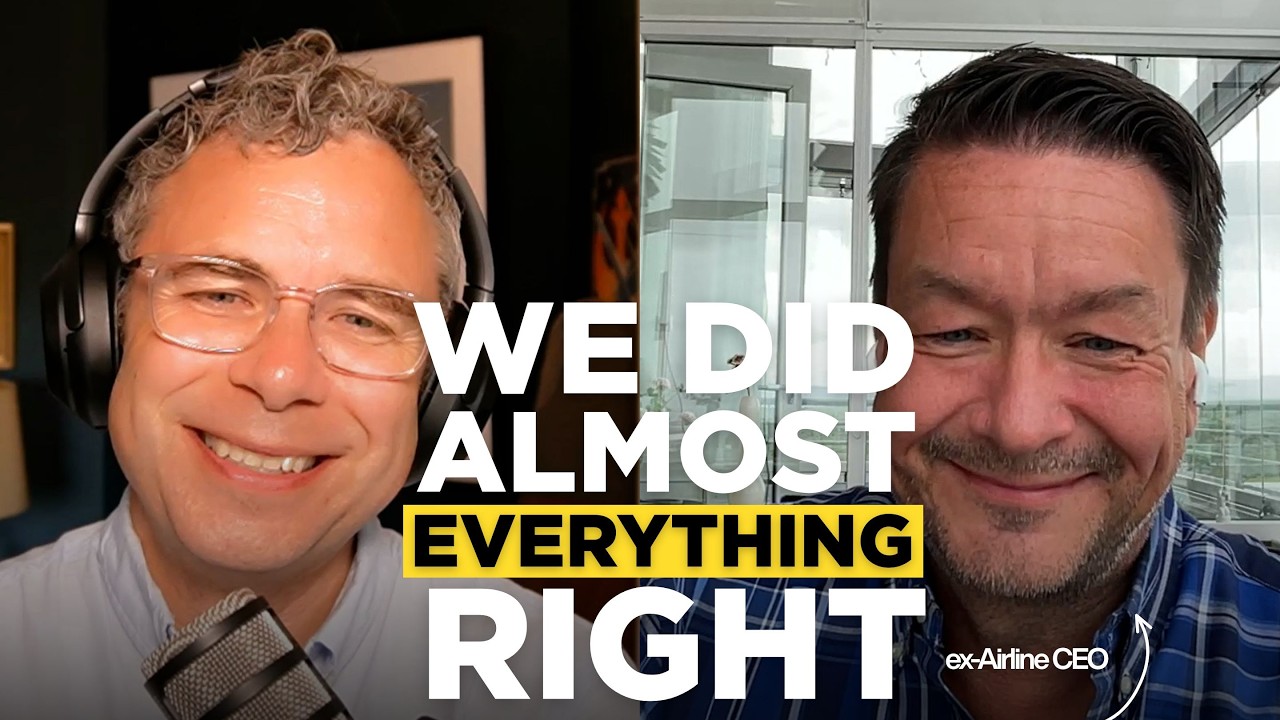
PLAY Airlines went from zero to $350 million in revenue in three years, executed nearly everything right — and still went bankrupt, because fuel prices don't care about your execution. Birgir Jónsson, former CEO of PLAY Airlines and veteran of WOW air and Iceland Express, unpacks why aviation structurally resists outside talent, why every airline rebuilds the same software stack from scratch, and how a single geopolitical shock can erase years of near-perfect operational work.
Show Notes
Birgir Jónsson has spent roughly twenty years moving in and out of Icelandic aviation — as CEO of Iceland Express, deputy CEO of WOW air, and most recently CEO of PLAY Airlines, where he led the low-cost carrier from pandemic-era launch through approximately $350 million in annual revenue before its bankruptcy. He also led a turnaround at Iceland's postal service and has held leadership roles in printing and medical equipment, giving him an unusually cross-industry lens on aviation's structural quirks. In this conversation, Birgir explains why aviation functions as a closed, self-referential community that makes it genuinely hard for outside talent to gain traction, and why the crew-versus-office cultural divide inside every airline creates alignment problems that straightforward metrics can't resolve. He argues that a modern low-cost airline is fundamentally a software stack — one that is far less standardized than outsiders assume, forcing even brand-new carriers to build their own distribution, inventory, and ancillary systems from scratch. The discussion moves into PLAY's Iceland-as-a-hub strategy between Europe and North America, how the Ukraine invasion triggered a fuel-price shock that broke the underlying model, and why near-perfect execution offers no protection against a single uncontrollable input cost. Birgir also reflects on the manager-gap problem that hits fast-scaling airlines, the realistic near-term role of AI in making complex internal data accessible, and why the durable value in aviation tech has historically accrued to infrastructure providers rather than the airlines themselves.
Read the takeaways
An Airline Is Just a Software Stack Nobody Finished Building
There's a moment in this conversation where my guest compares running an airline to selling hamburgers: your meat costs triple overnight, but you can't triple your menu price on the same day.
Read the newsletter issueFull TranscriptClick to expand (8,328 words approx.)
Alex Brooker: Hello, everybody. Welcome to the Travel Tech Podcast. My name is Alex Brooker, and this week's guest is Birgir Jonsson, the ex-CEO of Play Airlines. He's also been CEO of two other airlines in the travel industry. He's also been involved in a turnaround at the Postal Service in Iceland, and we have a fantastic conversation getting into stories about Play, starting up an airline, leadership principles, the challenges there, and a lot more besides.
I really hope you enjoy this content, brought to you by airsidelabs.com. Please don't forget to like and subscribe to the channel — it really helps me out — and please keep the comments coming in. I love reading and responding to your feedback. So without further ado, let's get into it.
Birgir Jonsson, welcome to the Travel Tech Podcast. It's great to meet you.
Birgir Jonsson: Thank you. Thank you so much. It's a great honor to be here. Thank you very much.
Alex Brooker: You're very welcome. And it's really fantastic — you are the first airline CEO we've had onto the pod. I'd love to get into some of those discussions, but first I'd love to ask you how you started. I think everyone would want to know how you originally got into the travel industry from the very beginning. How did it start?
Birgir Jonsson: I've often said I've been in and out of aviation. I've been either CEO or deputy CEO of, I think, three airlines, all here in Iceland. And it was like most things in life — something of an accident, or some kind of coincidence. I was CEO of an airline called Iceland Express, probably 20 years ago. Then I was deputy CEO of WOW Air for about a year and a half. And then lastly, CEO of Play Airlines, up until 2024. And apart from that, I've done a lot of things in business.
I've always tried to keep an outsider's perspective, so to speak. I've not really defined myself as an aviation guy or an airline guy, even though I have to admit that it is some kind of a virus. You get very, very interested, and I find myself being interested in the aircraft now. But I've tried to look at this as a business — a very narrow-margin business — and keep that kind of mindset about it. So I've been in and out for about 20 years here in Iceland.
Alex Brooker: Maybe we could just dwell on that. You mentioned an outsider's mindset. That's a really interesting perspective, because aviation is a bit like a bug — you sort of love it so much, and it attracts a lot of people, a lot of attention, and people build their careers because they love it so much. But how would you describe or define that outsider's perspective?
Birgir Jonsson: I mean, you could say it's a close-knit, family-business kind of culture. You go to the conferences, you see the same people, and they tend to move between companies and airlines. So it becomes a very tight-knit community — almost sometimes inbred. And I think one of the problems, which is of course sometimes a great advantage, is that you sometimes lack new blood, new talent in the industry. Because it's very detailed and specific. There are a lot of acronyms, and it's difficult for people to get into it.
For example, I was CEO of Icelandic Post here in Iceland — which is like the Royal Mail or something — I did a turnaround there. I've been CEO of a printing company in Eastern Europe. I've been in medical equipment. I've been in a lot of industries. And so I have the comparison, and it is difficult, I think, to get new people into aviation. That's a downside, because it's a very closed culture.
And also, there is a strange culture within airlines in general. You could look at it as one company, but it's a very divisive culture. You have the crews, you have the people at the office — who, according to the crews, usually don't know anything — and there's a culture that needs to be very closely managed. You can harness it for good, but there's also a downside. I've always tried to learn lessons elsewhere and bring them into my aviation experiences, without getting too in love with aviation. But like you said, it is hard, because it is a bug, and I'm afraid I've got a bad case of it.
Alex Brooker: So what sort of lessons have you learned through your career outside of aviation that you think aviation could learn from? What are some of those things done in other places that perhaps don't occur to an airline, an airport, or people in the travel tech industry?
Birgir Jonsson: Well, as a leader — and it's not only the CEO, there are many leaders in an airline — it is more difficult to unite employees and staff towards one specific goal, because they have different goals. The flight crews are looking at the world in a completely different manner than the people in the office, or the tech people, or whoever. So it becomes very complicated to motivate people and make sure that everyone is marching in the same direction, because the metrics are so different between the groups of people within the company.
When I was at Icelandic Post, you had metrics around how fast you could deliver packages, and everyone understood the metrics and the objectives. But in aviation, there are so many, and they're so complex. And in many cases, they're completely outside of your influence. I mean, you can have a great company, but if fuel prices are so high, nothing works business-wise. So you need to be absolutely sure of how to communicate very clearly many different things, in a way that people feel they have some kind of an impact. And that's a real challenge, at least for me, and for others leading these companies.
Alex Brooker: It certainly makes sense. It's a business with a safety-critical operational side, all those different teams, and very much also people back in the office — almost like multiple businesses running under one roof.
Birgir Jonsson: Yeah. It's a really interesting and enjoyable challenge, but many people that I've spoken to are very frustrated, because there are a lot of complex labor issues and all kinds of things that you don't usually have to deal with as much on a daily basis in other industries. It's a very dynamic and fast-moving industry, and different kinds of people thrive in that environment — and those are not always necessarily the same kind of people that give you stability within a company, for example.
Alex Brooker: And obviously you've seen that firsthand — at Iceland Express, at WOW, and then being involved near the very beginning of Play. How was that different in terms of starting, or being involved from the very early days of a new airline?
Birgir Jonsson: Yeah, and I think I'm very much speaking from that experience. When Play started, we often say it had a very shared DNA with WOW — the same kind of key management team came out of WOW and started Play. And then the pandemic hit.
Initially you had a very powerful group of people who were so grateful just to have a job in aviation. In a small country like Iceland, where there aren't too many other opportunities, that was a very powerful fuel to drive the company — people really wanted to work and didn't want to scatter their families around the world chasing jobs. They were so happy to have a job locally. And there was a kind of a can-do startup feeling, which is an extremely valuable and unique experience. So that was an advantage.
But again, when trying to get different, new people into the business, it was a challenge, because they often didn't get traction. The culture is so specialized. When you have that kind of culture and a new person comes in with their own creative ideas, often the people already there say, "No, we tried that at the old company and it didn't work," or "Yeah, we've done this all before." People can become jaded. New people just don't get traction and they leave — and that's a waste. I was always trying to get people to understand what the work is really about, and that's difficult in aviation.
Alex Brooker: That's interesting. What does that mean — what is it really about?
Birgir Jonsson: Well, one thing is that, if we talk about the technical side of things, aviation is not very standardized. So it's really difficult for people to get their heads around it. I mean, Play, for example — a startup low-cost airline — is basically a software stack. You see the aircraft and you see the crews, but at the end of the day, what really matters is something that's not tangible. You cannot see it. And it's not standardized between companies, so every company has their own unique stack.
Working in commercial or marketing in aviation, I find you have to be very data-oriented and very IT- or digital-oriented to understand what your job is and how to do it. And it's a constant communication challenge — you have to make sure that data and objectives are flowing between people, because it's much more complex than in other industries and much more fast-moving. You could be focused on a route in Canada one week, and then the following week something completely different demands all your attention. It's just more brutal and fast-moving than most other industries I've been involved in.
Alex Brooker: It sounds like I empathize with some of those complexities. But the way you described that startup mindset and that hunger — particularly for a homegrown airline in Iceland, people wanting to work and stay local — I can almost feel that passion and drive. And then faced with this barrier of complexity. Even with a brand new airline starting with a clean sheet, I'd be interested to hear you describe what some of those challenges were. Even without a legacy tech stack that's 50 years old and super complicated — you didn't have that. You were starting fresh. Could you talk about some of those challenges as you saw them?
Birgir Jonsson: Yeah. Because there is no... aviation is so interesting because everyone has an opinion. We all travel, and you've never gone through an airport with anyone without people thinking, "Why isn't it like this?" or "I never get any information." People simply don't understand the complexities running underneath.
So just for a new airline to be able to sell and distribute their inventory — make sure that people can buy a seat, buy the ancillary products, guarantee seats, whatever — you basically have to do all of that from the ground up as a new company. You cannot buy these products off the shelf, or very rarely. At least in our case, we just spent a lot of time and a lot of money making sure we got to the same level as other airlines, which everyone assumes is simple. "I mean, Ryanair can do it — why can't you do it in two months?" And people had to realize you had to build the whole thing from the ground up, because it is not standardized.
Just getting your seats and inventory into OTAs and booking sites — which is important for startup companies — there are very low standards around that. You cannot just plug into an API and be everywhere around the world. You have to do individual negotiations, and it takes a lot of time and a lot of money just to get to, I would say, a minimum viable level where you can actually run an airline. And that's very frustrating for many people — frustrating for investors who simply don't understand why you can't just be like easyJet on day one. "It's on the internet — it can't be that hard."
So it's about communication. And in our case, it took a lot of time, a lot of money, and a lot of explaining, and sometimes apologizing, and basically trying to educate a lot of people around the company that this just takes time and money.
Alex Brooker: I was messaging you on LinkedIn before recording this conversation, and I was pitching titles — saying, "Hey, we could do an episode called 'How to Start an Airline in 24 Hours.'" And from what you're describing, that's not possible, even with a clean sheet. Just the complexity of the tech alone — but also on the commercial side, significant deals having to be negotiated to get your inventory distributed?
Birgir Jonsson: Yeah. And again, it's a very close-knit community. It's very much a person-to-person thing — people have worked together before, or they used to do it a certain way at the old company. It's very old school, actually. You think aviation is very technologically developed as an industry, but it's really not.
And going back to my earlier point about having an outsider's perspective — people get very offended when you say that. Because they think that, for example, selling an airline seat — "We've been doing that for 30 years. This is the perfect e-commerce product." And still we are grappling with it, and always trying to reinvent the wheel. At least in those three companies I worked at.
Birgir Jonsson: And when people think of having a new company with no legacy, it's very easy because you can just get reborn with all the new technology, but it's not really like that. I mean, a legacy airline — a legacy means that it's just been taking these decisions for a longer time. It's not necessarily that you can have old and underdeveloped systems, and then the new guy can have a new and shiny system that is automatically much better than the old one.
It's not really like that, because you can very quickly find yourself that, okay, you've been running for five years and you've already created some kind of a legacy that means you've basically painted yourself into some kind of a corner. And people inside of aviation are very — they often get, in my experience, very hurt and offended if you point this out, that aviation is not as technologically progressed or fast-moving as we like to think.
Alex Brooker: I agree. But what should — maybe going back to that outsider's perspective, and particularly investors — in the news at the moment, there's a big European airline that's being discussed and talked about a lot. But what should people who are outside the industry, whether it's a startup or it's a turnaround or they're looking to invest, what sort of things should they be aware of? What would you say to them about aviation that they should know?
Birgir Jonsson: I mean, that's a very interesting question, because it has to be said at this point that Play did not end well. I mean, the company went bankrupt one and a half years after I left — this winter, now a couple of months ago. So it's not like we had a perfect start. Started after COVID, extremely well financed, launched, floated here on the Icelandic Stock Exchange. Very strong group of investors. We had a lot of cash.
And one thing that the pandemic gave us and many other airlines starting at that point is that there was an even playing field. If I would start an airline now and I wanted to launch this summer, my competitors would have been selling into the summer for six months before I launched myself. But in COVID, there was no order book anywhere. So everyone started at the same time. So I'm trying to say that the conditions were perfect, really — right until the Ukrainian war started and the oil price. And that's really basically what it is.
Aviation is so unbelievably connected to the fuel price. Actually, one investor asked me, after I did the pitch to him, he said, okay, why don't I just then back fuel? Why am I making this a more complex transaction by buying the airline that is then so heavily exposed? I didn't really have an answer to that, to be honest.
But it's been an interesting thing to look at. You mentioned the easyJet deal and Spirit Airlines in America. There's a lot of conversation in America about whether low cost is over. I mean, how is the aviation market developing? And investors should have deep pockets and understand the business a lot.
It's interesting, for example, to look at the easyJet discussion now because it's very emotionally charged. But these are private equity people buying into a very narrow margin business, and at the end of the day, that's all it is. It is a business, and if someone wants to sell and someone wants to buy, it's not really more complicated than that. And in aviation, we tend to take things more personally. I mean, you would not, if you're working for a company — an aluminium smelter or something. Of course, people matter. I'm not saying they don't matter, but at the end of the day, these are financial transactions on a global scale. And investors that are playing on that kind of level are looking at things from a much tougher and harder perspective than the employees, or people that just like looking at the aircraft.
Alex Brooker: Yeah. So why do you think it is more personal than if it was an aluminium smelter or just a commodities company or something? Why do you think there is that emotion in aviation and airlines? Why does that happen?
Birgir Jonsson: I mean, I think, like I said before, in many cases it is actually an advantage. You want people to feel something. You want your employees to feel something. You want customers to care about the brand and stuff like that. But at the end of the day, this is a very hard-charging, fast-moving business, and there are a lot of examples by the roadside that educate you on that reality.
At the end of the day, this is a transport business. I mean, I'm personally a big fan of Ryanair. And at the end of the day, it's about how cheaply you can buy your aircraft and basically how brutal you can be in running your business — almost like a train company or a bus company. And because we are not getting, like I said before, all this new blood into the business, there's almost some kind of a cabin fever within the industry. There's a lot of — you're in one team, you're in the orange team, you're in the blue team — it's almost like a football club. And I think that private equity people are not looking at it from that perspective. So there's a clash of cultures, which is very interesting to observe.
Yeah, the low margin — no kidding, it's a low margin. It's something like $10 or €10, if you're lucky, per seat. And you can do everything right. For example, Play — it was a great experience and a great company. When you explain to people here in Iceland that there was zero dollar turnover and no system to pay bills or process payments or whatever, and then three years later you're maybe turning over $350 million a year — it's an unbelievably fast growth. And you have to have the infrastructure and people to manage this kind of operation without everything exploding on a daily basis.
So you can do everything correctly, but then fuel per ton goes to $1,500 and nobody cares that you did everything else right. You don't get any points for that. And that's a very hard reality to have to face. You're not getting a D on your school report — you either just live or die, and that's a very tough reality. Because people can do a great job, the aircraft are flying on time, the service is perfect, the customers are happy, everything is good. But simply because fuel is very expensive, it slides out. And I think, business-wise and culture-wise, there's a clash there that some people deal with in a difficult manner and have a difficult time living with that reality.
Alex Brooker: Are there reflections since then, in the last year or 18 months? I know you've worked as a turnaround specialist in a few other companies. Have you had reflections and thoughts that you'd be willing to share about Play — when you think back to those few years? Or was it just fuel price as the driver?
Birgir Jonsson: I mean, I am not the kind of person that looks in the mirror and says, listen, there were no mistakes, everything was perfect, but the fuel was very high and that ruined everything. It's not like that. And if you're building a company from nothing — if you look at it in other industries — you have like 20 employees and then you're suddenly up to 600 employees and you have all these challenges. Of course it's crazy growth, crazy scale.
And in Iceland, we went from a company that didn't exist to being in the top 30 biggest companies in Iceland in three years. And that's an unbelievable pressure. And you're doing it on the stock exchange, so you have to explain everything. And there's a lot of speed and a lot of expectations from people — which I personally enjoyed — from general investors that simply do not understand aviation and simply do not understand why you can't have the same ancillary revenue as Ryanair from day one. And you had to have a lot of patience and take the time to explain that to people without apologising, just simply saying, listen, it's not a software solution you can buy off the shelf that's going to pop up on the first day fully perfect.
So I absolutely can see that we probably did some things wrong and made some mistakes we shouldn't have made, with the benefit of hindsight. Maybe one was that we were driving a business model using Iceland as a hub connecting Europe to the US with a stop in Iceland. That was a business model that has worked well in the past — for example, it worked well with WOW. And then the dynamic simply changed. There was a new type of aircraft that came in. With Ukraine, and also with the Israel-Palestine situation, a lot of capacity shifted to the Atlantic market. Asia was slower in opening up after the pandemic, so there was a lot of capacity shifting into that market. So we were probably going into a market that was fine a couple of years before but didn't really exist as we thought it did. And then we were probably a little bit slow in reacting to that.
But at the end of the day, this is also what you love about aviation — everything can happen in one day. What happens in a normal company in one year or ten years, you have that in aviation in one month. So I would like to look at it as a big success, but having said that, the company went bankrupt. I mean, you cannot be like a doctor that says the operation was perfect but the patient died. It doesn't work like that.
Alex Brooker: Yeah, that's a brutal way of putting it, but I suppose, yeah. Interesting. The way that geopolitics can really pull the rug out from underneath you very swiftly — and the way you described it, where if all the flights have to stop in one part of the world because something has just happened, those fleets get redistributed, massive competition comes in, and people start competitive airlines just swamping the market with those assets because they've got to use them.
Birgir Jonsson: Yeah. And the airlines that started during or after the pandemic have not really done so well, to be honest. And at the end of the day, it's about the fuel price. We used as our benchmark in our business cases $660 per ton, which was already a very high price based on the ten years before. As soon as the invasion of Ukraine happened, it went to $1,500. And if your cost base in any business — if I'm selling hamburgers and I'm selling them for £10 and my cost of meat goes from £3 to suddenly £9, I cannot sell it for £10 anymore. And that's basically what happens between Monday and Tuesday. You cannot just increase the price of a hamburger to £30 between days. It doesn't work like that. It's like being hit by a train.
And we see it now with Iran also. Airlines — what do they do? They cut capacity, they raise prices, but they cannot do it as fast as the fuel increases. The lag is too much. So there's always something. And if you look at the last couple of years in aviation, there's been a lot of this kind of big event that has completely — and I'm not even going to talk about the pandemic, but here in Iceland we had volcanoes going off also. It's like a computer game — what the hell is going to happen today? We have wars, it's going to be the four horsemen coming down the road. It's crazy. But that's the way it is.
Alex Brooker: It is. I had a wonderful journey from Split in Croatia all the way across Europe to get back to London a little over ten years ago when the volcanic ash cloud went across. That was actually a very enjoyable trip — going by train on that occasion instead of flying.
Birgir Jonsson: Yeah. I mean, it's a great point, actually, because there is a silver lining in this also. Because when that happened — the famous Eyjafjallajökull volcano went off — that was kind of the birth of a golden age of Icelandic tourism, because suddenly everyone in the world knew what Iceland was. I mean, when I was CEO of an airline here around 20 years ago, in 2004 and 2005, we had three, four, five hundred thousand tourists a year coming to Iceland. We are a nation of 400,000 people. For the last ten years, we've had two million plus every year. And that really starts with that eruption — when that happened, when you went to Croatia. So it was a great marketing ploy. A silver lining to the ash cloud.
Alex Brooker: I was just wondering, could we go back to the early days of Play? I think we've talked enough about the fuel price — I don't want to dwell too much on that side. But can we go back to the beginning? Because at the start of this conversation, you started talking about the startup culture and the passion. What were those early days really like?
Birgir Jonsson: I mean, obviously I came into it with my experience from other airlines, but also other companies. So I was very conscious that we were trying to build a culture that would, for example, bridge the famous gap between office and crews, and get people to communicate and understand what we were really doing this for. And it was very good to have a very well-funded company — I cannot complain and say that we didn't have the money. We had a lot of money. And so we knew that we were building a company that was going to last, we hoped. And so we really tried to do it the right way.
And that was also quite painful sometimes, because of the growth I mentioned — the zero to $350 million. It also puts a lot of pressure on leaders and managers within the company. Because, for example, if you're leading the maintenance team or the tech team, you start with like five people and then you're up to 50.
Birgir Jonsson: And maybe within the space of half a year or one year, cabin crew went from tens of people to hundreds of people. And that capacity — there's a CFO, you know, you're dealing with nothing and then you're dealing with $350 million in cash flow. And so it means that you're probably not always going to have the right people, or the same people, that can manage this kind of growth.
I mean, you would like to have the right people from the beginning, but those heavy hitters that can deal with $350 million plus cash flow are not going to want to join a startup. We knew that those challenges were coming and we were trying to just be open in talking about them with the people involved. You had to move really fast, and you'd have one department, and then within a space of 18 months that department is going to be probably split into five departments because the scale of the operation just grew.
We really tried to challenge people working in that kind of environment by having very open and honest communication — simply letting people know that you might be completely the right person now to lead this, but probably not in one year. Either you develop yourself, and we had a lot of cases where people did that, or you have to realise that you might want to continue to be an expert in what you do. Because being a manager and a leader is also an expertise.
So we spent a lot of time and a lot of money and a lot of focus on training people, making sure that even though you are a great maintenance or technical person, managing a 50-person department is a different skill set. You have your education and your certifications on how to maintain an aircraft engine, but you also need to be trained in how to be a manager and a leader. And if you don't have a culture where people are unafraid to come to you and say, "Listen, I need help with this. I don't know how to deal with people, or I feel insecure — what can I do and how should I handle these situations?"
We tried to anticipate that problem and spent a lot of time and money trying to train people for it, because we knew what the growing pains would be. We learned that at WOW and other companies. If you don't talk about these things openly and honestly, you get into a negative environment where people are pointing at others — "I'm great but this guy is not doing his job," or "I'm not going to tell you my problems because you'll use them against me or go to the manager." That kind of office politics often happens in fast-moving or fast-growing companies. I'm not going to sit here and say we were completely successful at avoiding it, but at least we tried hard.
And it was a very good time, but also often quite painful, because at the end of the day this was a company, an airline, with external investors, and those people look at things a little bit like what I said before about private equity. They just look at it differently. And building a company is not a birthday party for the people invited — there's another objective to it. And sometimes it can be a little bit brutal and a little bit lonely to be constantly explaining that to people, that there are external expectations you have to meet.
Alex Brooker: It's so interesting to hear you describe that journey. Are there some principles around leadership — starting with that small team at the beginning — that you've applied through that scaling journey up to 600? Starting with a small number and getting to 600, are there some principles of leadership you would share with perhaps some of the audience members who might be doing their own startups, not even in aviation but in travel tech, starting with a small team? How do you approach being a leader that can scale from small to hundreds of millions in turnover?
Birgir Jonsson: I think one of the biggest principles I have always tried to apply is being honest and open. Sometimes you just cannot always be nice, and I'm not talking about being some kind of dictator. I think what I just described is a perfect example of that. You have to basically ask: what are we doing? What are the expectations of the people giving us money? And what can you bring to the table? At some point, you cannot handle the job.
This kind of open communication is good. I know it sounds a little bit harsh, but if you can do it without ego and without offending people, you just put it this way — everyone knows that playing in a football club in the third division is a different skill set from playing in the Premier League. Either you get really good at football in a very short period of time, or we will need to bring in Premier League level players. And if you have a culture where people understand that — because everyone really does understand it — then that's a good starting point.
If people are unafraid to communicate and ask questions and talk about their shortcomings, and also about their successes, and if you have an honest culture within the company — and that's true of any business I've ever worked at — then you're in a good place. But the truth is not always easy to handle, and that's maybe where the honesty really comes in. You have to be able to look in the mirror and say, "Listen, either I need to change a lot, or I'm not the right person for the job." And I think that's a principle that can be applied in many industries.
Alex Brooker: Absolutely fascinating to hear you describe that. I think in many cases they know, and it's almost a relief when a leader handles it the way you've described — it's almost a relief when you start to have that conversation. So placing honesty at the heart of it.
Birgir Jonsson: Yeah. I mean, if you can do it without being an asshole — basically you're not saying that someone is a failure. We know that. And you are also giving the individual the opportunity and the tools to develop. You're saying: I'm giving you training, I'm giving you education — if you want to put in the work. And again, we have many, many cases where people took that development journey, and it's great to see.
One of the things that gives me the most satisfaction is seeing, for example, all the Play people going on to bigger roles and bigger companies, basically using what they learned and building their own careers. And that's a beautiful thing. That's probably one of the biggest positives that comes out of this kind of experiment, or this kind of project, within a small country. It's an enriching thing for society, for the economy. A lot of people here have gone into different companies carrying a lot of international experience that they learned from WOW or Play or other airlines — experience they would not have had coming from a small rock in the North Atlantic.
Alex Brooker: Have there been new businesses born from that? Has that spirit and passion stayed in aviation, or have people spread out?
Birgir Jonsson: Yeah, there have been some tech companies — some people have gone into that. And of course many people, the crew, many of them have moved into other areas, in Iceland or somewhere else. But at the end of the day, it's a place of work. And if it doesn't work, then people will find their paths in life. And again, that's a very important thing for a small country to have — that someone is willing to risk a high-risk-profile investment in aviation. The benefits might show up in other places for an economy, rather than in that company itself, even though we would all have liked it to work out. That's how it is.
And maybe people see the challenges they weren't able to tackle in that context, but they can build something to tackle those same challenges by other means. Another interesting thing now — which was not really an issue two years ago — is how airlines find their place in an AI-driven world, which is a completely fascinating thing. And I know a lot of people here who have been working within Play and WOW who are starting or working on those kinds of solutions, which is interesting to see.
Alex Brooker: Yeah, I was wondering when we would get to the topic of AI. But I'm very pleased we talked about the people and leadership principles first — that's something we haven't really covered on this podcast before. It's been very technical, talking about distribution and APIs and things like that. So it's really refreshing to talk about some of those other things, the human side of growing a business. So in terms of the AI opportunity, what's your take on where AI might impact aviation the most, or where the greatest opportunity is, as you see it?
Birgir Jonsson: Well, I'm absolutely not an expert on that. But what I do see is — like I mentioned before — both external investors and people within aviation think the industry is much more technically advanced than it actually is. I see a lot of chaos. Everyone's talking about buzzwords, there are a lot of startup companies, and everyone's kind of chasing their own tails.
In terms of airlines — how do you get your inventory talking to these agents? I mean, when we were messaging before the podcast I was saying, listen, it's very recent that you can go on Expedia or these OTAs and select your bags and your seats, because usually you bought a seat and then everyone was fighting about who had the data, and then the flight got cancelled and no one knew who the passenger was, and you were trying to reach the customer to sell them an extra bag or a seat upgrade. This is like 20 years after this technology came onto the market.
So I would be very surprised — and maybe I'm an old Icelandic cynic — but I'm going to be very surprised if aviation is so quick to adapt to AI that it all happens in the next few months or one or two years. When people are asking, "Get me the best flight to New York," and there's an airline that can just tap into that channel — I hope it's going to happen. It needs to happen. But I'm not going to hold my breath. There are a lot of things that have to happen before the industry simply takes that and solves it.
Alex Brooker: Yeah. So maybe more on the discovery, intent, and travel inspiration side rather than the nuts and bolts of booking a flight?
Birgir Jonsson: Well, that's a good point actually, because there are a lot of uses for AI. Of course, AI internally within an airline is immensely helpful — as it is in all businesses — but maybe especially in an airline, because it's so data-driven and you need to be able to execute your decisions with much more detachment than in other industries, at least the ones I've been in. It's fast-moving. There are so many different data points that can influence a decision.
Going back to my earlier point about getting new blood into the industry — I come from a commercial background, and I've sat in commercial meetings with new people who maybe had great track records in other industries. And they simply don't understand what it's about. You're talking about load factors and median prices, and then you have like 200 destinations and it's all happening at once — and it's like, where do I even start? An AI solution that can simply make it more palatable and understandable for new people, that's going to solve a lot. If it can just make it simpler — what is the action plan, how do we deal with this — I think that's going to be very helpful.
And then of course within the operation, all the data and documentation — there's a lot of backend manual work, for example, connected to maintenance or route planning, where you'd have some guru sitting in a corner who knows everything, and that's not really the way forward. We've been relying on real intelligence, but I think artificial intelligence can help a lot with that.
Alex Brooker: Because it sounds like, from your description, it's an incredibly complex business. There's so much to it, and it's super time-sensitive and fast-moving. Maybe just helping humans handle it more effectively can really make a difference.
Birgir Jonsson: And also from the point I made before about bringing in new people — they're often talking to people who have been working in this for such a long time that they're almost jaded or tired, and they don't really want to start explaining everything to someone who just joined or just graduated. I think AI can help with that — people can maybe focus on what they are really good at, taking manual processes out of the equation, and making the whole thing less overwhelming. Because you can get bogged down with all the details and you kind of lose perspective.
Alex Brooker: Yeah, it can be very distracting. Listen, Birgir, we've been talking for almost an hour. It's been absolutely amazing and fascinating to hear your story and learn about what happened with the business. But what have I not asked you that I should have? Where are the gaps? Where have I missed something?
Birgir Jonsson: That's a good question. I mean, I don't really know, to be honest. The only thing I would kind of want to leave with is — restating what I said before — is that in aviation you can do everything else, you can do like 99% perfectly, but there's this 1% that's going to get you. And I'm talking about Play — it was a great experience, but at the end of the day, it went bankrupt. And I think that's the brutal thing you have to keep in mind, and you have to make sure the people working with you know it too: there is a bullet flying around that you don't see coming, and you have to somehow be prepared for it. We like the risk, but it's not really nice when it gets you.
Alex: Is there a message — because we meet a lot of founders, or startup founders, on this podcast, particularly in aviation tech and travel tech, trying to solve some of these problems and make some money selling into the travel industry. What would be your message for them? Not necessarily starting an airline, but they're starting an AI company or tackling some of these issues?
Birgir: I mean, there's a huge list of problems that need to be solved. And like I've been trying to say, with a new world order, AI is a big buzzword and all that. But if someone can — and of course many people are doing it — bring real solutions to that table, then there's real money to be made.
And it's like everything else. I mean, you know, people made money from the gold rush where the people selling the shovels — it's not really the people who found the gold. So most people around airlines make money; it's not usually the people founding the airlines. So I would say keep starting up those companies and solving those problems, because there's a lot of problems to be solved, which is good. There's a lot of opportunity out there.
Alex: That's a fantastic note to end on. How can people reach out to you? I reached out to you on LinkedIn.
Birgir: Yeah, I'm on LinkedIn. I'm too old for everything else. But LinkedIn is great for aviation — so much content, you learn so much every day, and so many great people are willing to share their experiences. And again, coming from other industries, aviation is unique in that way on LinkedIn. It's really a great community, you learn a lot, and I meet great people like yourself.
Alex: Thank you very much. Well, likewise — it's been absolutely amazing. Thank you so much for joining me and recording this conversation. I'm sure the audience is going to absolutely love it. Thanks again.
Birgir: Thanks a lot. My pleasure. Thank you.
Ep 26: Nobody Would Fund a Human for This
Ep 28: The Feedback You Don't Notice You're Getting
Related episodes
Episode 39
Can ChatGPT Find Your Hotel? Answer Engines, a Fleet of 17 Agents and One Rule Against AI Slop
Jascha Kaykas-Wolff
Episode 30
Why Can't I Just Book My Own Trip? Dual Identity, Dreadful Booking Tools and the Real Job of Corporate Travel
Caitlin Gomez
Episode 21
96% Human Error: Why AI Security Starts with the Human, Not the Model
Yagub Rahimov
Every episode, in your inbox
One email per Travel Tech Podcast episode: the conversation, the key takeaways and the use cases worth building in aviation and travel AI.
Give your agent aviation tools
General assistants guess at aviation codes and get them wrong. Agent Tools give Claude, ChatGPT or your own agent checked answers instead. Free plan, no card.
Connect your agentAbout the Travel Tech Podcast
Hosted by Alex Brooker, founder of Airside Labs, the Travel Tech Podcast features authentic long-form conversations with leaders, innovators, and startup founders shaping the future of aviation and travel technology. No scripts, no sponsors, no sales pitches — just real conversations about building technology that matters.
Have a story from travel or aviation tech? Come on as a guest.